
|
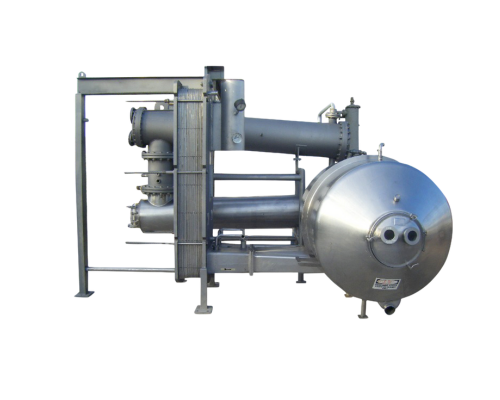
Plate Heat Exchangers consist of a number of very thin corrugated stainless
steel heat transfer plates clamped together in a frame. Every second channel is open to
the same fluid. Between each pair of plates there is a rubber gasket, which prevents
the fluids from mixing and from leaking to the surroundings. Heat is thus
transferred from the warm fluid to the colder fluid via the thin stainless steel
plate. The corrugations support the plates against differential pressure and create a
turbulent flow in the channels. In turn, the turbulent flow provides high heat transfer
efficiency, making the plate heat exchanger very compact compared with the traditional
shell-and-tube heat exchanger. In most cases the plate type heat exchanger is the most
efficient heat exchanger. Generally it offers the best solution to heating and cooling
applications since it can better handle the widest pressure and temperature limits.
Advantages of a plate heat exchanger are that they utilize the thinnest
material for the heat transfer surface that in turn gives optimum heat transfer, since
the heat only has to penetrate thin material. Also, there is a high turbulence in the
medium that in turn gives a higher convection, which results in efficient heat transfer
between the media. The consequence of this higher heat transfer coefficient per unit
area is not only a smaller surface area requirement but also a more efficient process.
The high turbulence also gives a self-cleaning effect. Therefore, when compared to the
traditional shell and tube heat exchanger, the fouling of the heat transfer surfaces is
considerably reduced. This means that the plate heat exchanger can remain in service far
longer between cleaning intervals. Since the plate heat exchanger consists of a
framework of plates, more plates can easily be added to increase capacity, and the
plates can easily be spread apart for cleaning.
Disadvantages of plate heat exchangers are their initial expense, they don't
work well under high pressure rates and they are not well suited for processing pulpy
products or product with particulates. The corrugated plate causes contact points that
are required for rigidity, and "pinch" points are created which allow for retention of the
pulp and particulates. This effectively creates an undesirable filter. This limits
your ability to process more than one type of product on a single system, such as
orange juice with pulp and a clear fruit drink that must contain no pulp. Trying to
keep the plate heat exchanger clean before running a new product can prove very
difficult, if not impossible.
|