

In industrial refrigeration, everyone knows the big players: compressors, evaporative condensers, vessels, pumps, evaporators, and miles of piping.
But behind all of that equipment is another critical job happening constantly:
Moving heat from one place to another.
That's where heat exchangers come in.
A plate-fin heat exchanger may not be the first piece of equipment that comes to mind when you think about an industrial refrigeration system, but in the right application, it can be an incredibly effective way to transfer heat while keeping equipment compact and efficient.
For refrigeration engineers, plant managers, contractors, and maintenance professionals, plate-fin heat exchangers can be especially interesting when space is tight, temperature differences are small, multiple streams need to exchange heat, or the system needs to recover energy that would otherwise be lost.
And as anyone who has ever dealt with a refrigeration equipment failure knows, the equipment doesn't have to be the biggest thing in the plant to cause a very big problem when it goes down.
First, What Is a Plate-Fin Heat Exchanger?
A plate-fin heat exchanger is constructed from layers of plates and corrugated fins.
The plates separate the different fluid streams, while the fins create flow passages and increase the amount of surface area available for heat transfer.
That gives engineers a way to put a tremendous amount of heat-transfer surface into a relatively small package.
Depending on the design, a plate-fin heat exchanger can also handle multiple streams within the same core.
In practical terms, that means one exchanger can sometimes perform several heat-transfer duties that would otherwise require multiple pieces of equipment.
For industrial refrigeration systems, that can mean an opportunity to save space, integrate different parts of the process, and make better use of energy already available in the system.
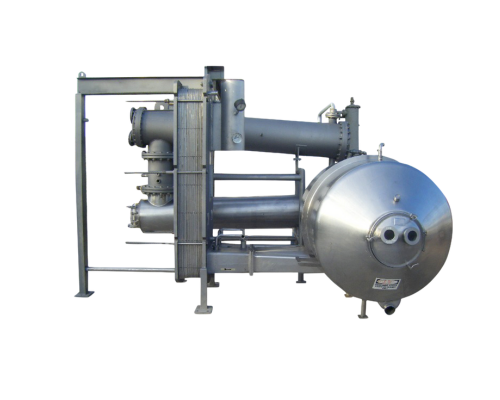
Image from Genemco
Link to Plate-Fin Heat Exchangers
Where Do Plate-Fin Heat Exchangers Fit in Industrial Refrigeration?
The answer depends heavily on the refrigeration system and the process it serves.
Industrial refrigeration isn't one-size-fits-all. A cold storage warehouse has different requirements than an ammonia refrigeration system serving a food processing plant, and a cryogenic gas application is different again.
But plate-fin heat exchangers can be useful in several areas where refrigeration and process cooling overlap.
Refrigerant-to-Process Heat Transfer
One potential application is transferring heat between a refrigerant and a process fluid.
The refrigeration system provides the cooling capacity, while the heat exchanger transfers that cooling effect to the process without the refrigerant and product necessarily coming into direct contact.
This can be useful in applications where a process stream needs to be cooled to a specific temperature.
The exact refrigerant, process fluid, pressure, temperature, and exchanger construction all need to be evaluated, but the underlying concept is straightforward:
The refrigeration system removes the heat. The heat exchanger helps move that heat where it needs to go.
Process Cooling in Food & Beverage Plants
This is where industrial refrigeration and food processing really start to overlap.
Food and beverage facilities can have a long list of cooling requirements:
- Product cooling
- Ingredient cooling
- Process water cooling
- Glycol systems
- Brine systems
- Fermentation cooling
- Beverage processing
- Dairy processing
- Meat and poultry processing
- Cold storage
- Ice production
A plate-fin heat exchanger can be considered when a process needs efficient heat transfer in a compact package.
For example, a refrigeration system may be used to cool a secondary fluid such as glycol or another heat-transfer fluid. That chilled fluid can then circulate throughout the facility to provide cooling where it's needed.
The refrigeration equipment doesn't necessarily have to sit right next to the production line.
The heat exchanger becomes part of the connection between the refrigeration system and the process.
Heat Recovery: Refrigeration Can Give Back, Too
Industrial refrigeration is usually thought of as something that takes heat away.
But that heat has to go somewhere.
And sometimes, that "waste" heat can actually be useful.
Depending on the system, heat rejected from a refrigeration process can potentially be recovered and used for applications such as:
- Water heating
- Process heating
- Wash water
- Space heating
- Preheating process streams
Heat exchangers can play an important role in making that possible.
Plate-fin designs can be particularly useful where a compact exchanger with a high amount of heat-transfer surface is desirable.
Rather than looking at refrigeration solely as an energy consumer, heat recovery allows the system to become part of a larger energy strategy.
In a large plant running around the clock, that's worth paying attention to.
Gas Cooling and Refrigeration
Industrial refrigeration isn't limited to cooling liquids.
Gas streams may also need to be cooled as part of a process.
Plate-fin heat exchangers can be used for certain gas-cooling applications because their finned construction provides a high heat-transfer area in a compact package.
This becomes particularly relevant when industrial refrigeration overlaps with:
- Natural gas processing
- Industrial gases
- Cryogenic applications
- Chemical processing
- Petrochemical processing
In these applications, the heat exchanger may be one part of a larger refrigeration or process-cooling system.
Ammonia Refrigeration Applications
Ammonia has been a workhorse refrigerant in industrial refrigeration for decades.
It's used throughout food processing, cold storage, beverage production, meat and poultry facilities, ice plants, and other large-scale refrigeration systems.
Heat exchangers can be incorporated into ammonia systems in a variety of ways depending on the system design.
One example is using ammonia refrigeration to chill a secondary fluid such as glycol or brine, which then provides cooling throughout the facility.
This can allow the refrigeration system and the process to be connected through a secondary loop.
Plate-fin technology may be considered where the application benefits from compact heat-transfer equipment and efficient thermal performance.
However, ammonia service requires careful consideration of pressure, materials, design, codes, and compatibility. The specific exchanger must always be matched to the intended service.
Refrigeration Heat Recovery
Here's another area that deserves attention.
Industrial refrigeration systems reject a significant amount of heat.
Instead of sending all of that heat directly into the environment, some facilities can recover it.
A heat exchanger can capture heat from a refrigeration system and transfer it to another fluid.
For example, heat recovered from a refrigeration system might be used to preheat water.
The refrigeration system continues doing what it was designed to do—remove heat from the process—but now some of that rejected energy is being put to work somewhere else.
It's a good example of how the individual pieces of a refrigeration system can become part of a larger facility-wide energy strategy.
Why Choose Plate-Fin Over Another Heat Exchanger?
Plate-fin heat exchangers aren't automatically the right choice for every industrial refrigeration application.
That's important.
A gasketed plate heat exchanger may be a better fit for some liquid-to-liquid applications.
A shell-and-tube exchanger may be preferred where high pressure, high temperature, fouling, or mechanical cleaning are major considerations.
A scraped surface heat exchanger is specifically designed for products that are viscous or prone to sticking.
A tube-in-tube exchanger may be a practical solution when simplicity and straightforward maintenance are priorities.
Plate-fin heat exchangers bring their own strengths.
They can be attractive when a system needs:
- A compact footprint
- High heat-transfer surface area
- Efficient thermal performance
- Multiple-stream heat transfer
- Gas-to-gas heat transfer
- Close temperature approaches
- Low-temperature or cryogenic service
- A high amount of heat transfer in a relatively small package
The right equipment ultimately comes down to the application.
Image from Genemco
Link to Plate-Fin Heat Exchangers
When a Heat Exchanger Failure Becomes a Production Problem
Anyone who has spent time in an industrial refrigeration plant knows that equipment failures have a way of happening at the worst possible time.
The replacement equipment is ordered.
The production schedule is full.
Maintenance has already been stretched thin.
And then someone asks:
"How long until we can get a new one?"
The answer might be weeks or months.
That's where the pre-owned industrial equipment market can provide a valuable alternative.
A used heat exchanger may be able to serve as a temporary replacement, supplemental capacity, or bridge while a new unit is being manufactured.
It doesn't necessarily have to be the forever solution.
It just has to help keep the operation moving until the forever solution arrives.
Why Consider Genemco?
This is where Genemco brings something different to the conversation.
We've spent decades working with pre-owned industrial refrigeration and food processing equipment.
That means we understand that when you're looking for equipment, you're usually not just shopping.
You're solving a problem.
Maybe your existing heat exchanger failed.
Maybe your plant needs additional cooling capacity.
Maybe you're waiting on a new system.
Maybe a project has suddenly been accelerated.
Or maybe a piece of equipment is available on the used market that can solve the problem much sooner than a new build.
Genemco's large inventory of pre-owned industrial equipment gives customers another place to look when the traditional new-equipment timeline doesn't work.
And because inventory changes, the equipment that's available can change quickly.
For a specialized piece of equipment like a plate-fin heat exchanger, we'll help you explore what's available and determine whether a pre-owned option could make sense for the application.
Sometimes the biggest benefit is simply having another option.
OEMs: We Don't Want to Take Your Customer
If you're an OEM, we want to make this part crystal clear:
We don't want to take your sale.
We want to help you protect it.
You've designed the system. You've made the recommendation. You've earned the customer's trust.
But what happens when the customer needs the equipment now and the new unit won't be ready for months?
That's where Genemco can help.
Think of us as the bandaid that helps your customer get through a temporary equipment problem.
And if the situation is more serious?
Maybe we're the tourniquet that helps keep the operation running until your new equipment arrives.
The important part is that you remain the hero.
Your customer still gets the new equipment they purchased from you.
You still deliver the long-term solution.
Genemco simply helps bridge the gap.
Instead of telling your customer, "You'll have to wait," you can potentially give them another option:
"Let's see if Genemco has something that can keep you running until your new equipment arrives."
That's a very different conversation.
And it's one that can help strengthen the relationship between an OEM and its customer rather than put it at risk.
The Bottom Line for Industrial Refrigeration
Plate-fin heat exchangers may not be the first thing you think of when you picture an industrial refrigeration system.
But when the application calls for compact equipment, efficient heat transfer, multiple streams, or heat recovery, they can be a valuable part of the system.
And when that heat exchanger—or another critical piece of refrigeration equipment—needs to be replaced, waiting isn't always an option.
That's where Genemco can help.
With a large inventory of pre-owned industrial refrigeration and food processing equipment, we give contractors, plant operators, engineers, OEMs, and maintenance teams another resource when they need equipment.
Because sometimes the goal isn't finding the equipment that will be there forever.
Sometimes the goal is finding the equipment that keeps you running until forever gets there.


