

In most industries, saving a little space is nice.
In aerospace and transportation, space and weight can be the whole game.
An aircraft can't simply be made larger because an engineer needs another heat exchanger. A spacecraft certainly can't afford to carry unnecessary weight. And a high-performance vehicle has to manage heat without turning its cooling system into half the vehicle.
That's one reason plate-fin heat exchangers have found an important place in aerospace and transportation applications.
They offer something engineers in these industries value tremendously: a lot of heat-transfer capability in a relatively small and lightweight package.
While the applications are very different from the large industrial refrigeration systems and food processing equipment we're accustomed to seeing in industrial facilities, the fundamental challenge is surprisingly familiar.
Something gets hot. Something needs to get cooler. And the heat has to go somewhere.
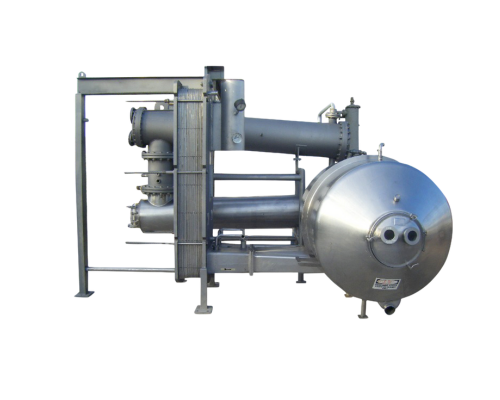
Image from Genemco
Link to Plate-Fin Heat Exchangers
What Makes Plate-Fin Heat Exchangers a Good Fit?
A plate-fin heat exchanger uses alternating plates and corrugated fins to create multiple flow passages and a large amount of heat-transfer surface.
That design allows engineers to achieve substantial heat transfer without requiring the physical size of a traditional exchanger designed for the same duty.
In aerospace and transportation, that can be a major advantage.
Every pound matters.
Every inch matters.
And every system has to earn its place.
The compact construction of plate-fin heat exchangers can help engineers package thermal-management equipment into tight spaces while still achieving the required cooling or heating performance.
Aerospace: Managing Heat at 30,000 Feet
Aircraft are essentially flying thermal-management systems.
Engines generate enormous amounts of heat. Hydraulic systems generate heat. Avionics generate heat. Passenger cabins need temperature control. Fuel needs to remain within appropriate operating conditions.
All of those systems have to work while the aircraft is moving through an environment that can be extremely cold outside.
That's a lot to manage.
Plate-fin heat exchangers can be incorporated into aircraft thermal-management systems to transfer heat between different fluids and gases.
Applications can include:
- Engine cooling
- Hydraulic system cooling
- Lubrication oil cooling
- Fuel cooling
- Environmental control systems
- Avionics cooling
- Air conditioning
- Cabin temperature management
The exchanger itself may be relatively small, but its job can be critical.
Aircraft Engine Cooling
Jet engines operate at extremely high temperatures.
That heat needs to be managed carefully to protect components, maintain performance, and keep the engine operating within its intended parameters.
Heat exchangers can transfer heat from engine oil, hydraulic fluid, fuel, or other fluids into another cooling medium.
Plate-fin construction can provide the high surface-area-to-volume ratio needed to accomplish significant heat transfer without adding excessive size or weight.
In an aircraft, that's a big deal.
On a factory floor, an extra 50 pounds of equipment may not dramatically change the design.
On an aircraft, 50 pounds is 50 pounds that has to be lifted into the sky on every flight.
That's why compact thermal equipment matters.
Fuel Cooling and Fuel Thermal Management
Fuel isn't only there to power the engine.
In some aircraft systems, fuel can also play a role in thermal management.
Heat exchangers can transfer heat between fuel and other fluids, helping control fuel temperature while simultaneously cooling another system.
This is a great example of why multi-stream heat transfer can be valuable.
Instead of treating every cooling requirement as an isolated problem, engineers can use the energy already moving through the aircraft to help manage other systems.
The result is a more integrated thermal-management system.
Hydraulic System Cooling
Aircraft rely on hydraulic systems for many critical functions, including flight controls and landing gear.
Hydraulic fluids can become hot during operation, particularly under demanding conditions.
Heat exchangers can help remove that heat and maintain hydraulic fluid within an acceptable temperature range.
Again, compactness matters.
A hydraulic cooling system has to fit into an aircraft where available space is limited and weight is always being scrutinized.
Plate-fin technology can provide substantial heat-transfer surface in a relatively compact package.
Avionics and Electronics Cooling
Modern aircraft contain an enormous amount of electronics.
Navigation systems. Communication equipment. Flight computers. Sensors. Displays. Radar.
And electronics produce heat.
As aircraft technology continues to advance, thermal management becomes increasingly important.
Heat exchangers can be part of the cooling architecture used to protect sensitive electronic equipment.
The goal isn't simply to make something cold.
It's to keep temperatures within a very specific operating range so that electronic systems can continue performing reliably.
Environmental Control Systems
If you've ever wondered how an aircraft maintains a comfortable cabin while flying through freezing temperatures at altitude, the environmental control system deserves some credit.
Aircraft environmental control systems manage cabin temperature, pressure, ventilation, and air conditioning.
Heat exchangers can be incorporated into these systems to cool and condition air before it enters the cabin or other areas of the aircraft.
Plate-fin designs are well suited to air-to-air heat transfer because the fin structure provides a large amount of surface area for the available space.
Military & Defense Applications
The same characteristics that make plate-fin heat exchangers useful in commercial aviation can make them attractive in military and defense applications.
Military aircraft and vehicles often operate in demanding environments where thermal loads can be high and available space is limited.
Thermal-management systems may be required for:
- Engines
- Hydraulics
- Electronics
- Avionics
- Fuel systems
- Environmental control
- Auxiliary power systems
In these environments, equipment may need to provide high performance without adding unnecessary weight or taking up valuable space.
That's exactly the type of design challenge plate-fin heat exchangers are built to address.
Transportation: Heat Management Doesn't Stop at the Airport
The aerospace industry may have the most obvious need for lightweight equipment, but transportation has plenty of thermal challenges of its own.
Plate-fin heat exchangers can be found in or considered for applications involving:
- Rail transportation
- Heavy-duty vehicles
- Marine transportation
- Automotive systems
- Specialty vehicles
- Power-generation equipment used in transportation
The specific applications vary, but the objective remains familiar:
Move heat efficiently without making the system unnecessarily large or heavy.
Rail & Locomotive Applications
Locomotives generate a tremendous amount of heat.
Engine cooling, transmission systems, charge-air cooling, and lubrication systems all require thermal management.
Plate-fin heat exchangers can be used in certain locomotive cooling systems to transfer heat away from engines and other components.
For rail equipment, reliability is particularly important.
A locomotive isn't exactly convenient to pull over when something overheats.
Efficient cooling can help protect equipment and support reliable operation under heavy loads and long operating cycles.
Heavy-Duty & Commercial Vehicles
Trucks, buses, construction equipment, agricultural machinery, and other heavy-duty vehicles also generate substantial heat.
Engine oil, transmission fluid, hydraulic systems, charge air, and other components may require cooling.
Plate-fin heat exchangers can provide a compact way to transfer heat from these systems.
The same concept applies here as it does in aerospace:
More cooling capacity doesn't necessarily mean you want a bigger cooling system.
You want the cooling system to provide the required performance while fitting within the available space.
Marine Transportation
Ships and marine vessels have their own unique thermal-management challenges.
Engines, generators, hydraulic systems, compressors, and other equipment all generate heat.
Plate-fin heat exchangers can be used for certain marine cooling applications where compactness and efficient heat transfer are important.
On a vessel, equipment footprint can matter just as much as it does in other transportation applications.
Every additional piece of equipment requires space, piping, structural support, and maintenance access.
Compact heat-transfer equipment can help simplify that equation.
Why Plate-Fin Heat Exchangers Instead of Shell & Tube?
Shell-and-tube heat exchangers are incredibly common throughout industrial applications and can certainly be used in transportation-related systems.
But transportation creates some unique priorities.
Plate-fin heat exchangers can offer:
- Compact construction
- High heat-transfer surface area
- Lower equipment weight in certain designs
- Efficient heat transfer
- Multiple flow configurations
- Good performance in space-constrained applications
That's why the technology can be particularly attractive when an engineer has to answer the question:
"Where are we going to put this?"
And in an aircraft, vehicle, locomotive, or marine vessel, that question can be surprisingly difficult to answer.
The Industrial Connection
At first glance, aerospace and industrial refrigeration may seem like completely different worlds.
But there's a common thread.
Thermal management.
The same fundamental principle applies whether you're cooling an aircraft hydraulic system, an industrial process, or a refrigeration system:
Heat has to move from somewhere it isn't wanted to somewhere it can be handled.
That's why the same basic heat-transfer technologies show up across so many industries.
The equipment may look different.
The operating conditions may be wildly different.
But the engineering problem is remarkably similar.
What Happens When the Equipment You Need Has a Long Lead Time?
Here's where things get back to a problem every industrial professional understands.
You need equipment.
You know exactly what you want.
You've placed the order.
And then you get the lead time.
Sometimes the project schedule and the equipment schedule don't exactly see eye to eye.
Maybe a replacement unit is needed sooner than the manufacturer can build it. Maybe a production line can't wait. Maybe a customer has an aircraft, vehicle, or industrial system that needs to stay operational while a permanent component is being manufactured.
That's when pre-owned equipment becomes worth investigating.
A used plate-fin heat exchanger may provide an interim solution, additional capacity, or a replacement option depending on the application.
It doesn't have to be the final chapter.
It may just need to get you to the next chapter.
Why Consider Genemco?
Genemco specializes in buying, selling, and appraising pre-owned industrial refrigeration and food processing equipment.
While our roots are firmly planted in the industrial equipment world, our inventory and experience extend into equipment used across a variety of processing and thermal applications.
When you're looking for a specialized heat exchanger, one of the biggest advantages of the pre-owned market can simply be availability.
Instead of waiting for a unit to be fabricated from the ground up, there may be an existing piece of equipment that could potentially fit the application.
Of course, used equipment needs to be evaluated carefully.
Configuration, materials, pressure rating, temperature range, connections, condition, and intended service all matter.
But when the alternative is shutting down or waiting months for new equipment, it's an option worth exploring.
OEMs: We're Not Trying to Steal the Spotlight
If you're an OEM, we understand something very important:
You earned the sale.
We don't want to step into that relationship.
We want to help you strengthen it.
Imagine you've sold your customer a new heat exchanger or thermal-management system, but the equipment has a long lead time.
Your customer still needs to operate.
They still have production schedules.
They still have customers of their own.
That's where Genemco can potentially help.
Think of us as the bandaid that helps keep things moving while the new equipment is being built.
And if the situation is more serious?
Maybe we're the tourniquet that helps keep the operation alive until the permanent solution arrives.
But the important part is this:
You remain the hero.
You made the sale.
You designed the long-term solution.
You helped your customer find a way to keep operating while they waited.
Genemco simply provided another resource to help bridge the gap.
That's the kind of partnership we want with OEMs.
We're not trying to replace the new equipment.
We're trying to help your customer survive the wait for it.
Image from Genemco
Link to Plate-Fin Heat Exchangers
Small Equipment. Big Responsibility.
A plate-fin heat exchanger might not be the biggest component on an aircraft, locomotive, truck, ship, or industrial system.
But its job can be significant.
When temperatures need to be controlled, critical components need protection, and space is limited, efficient heat transfer becomes essential.
That's why plate-fin heat exchangers continue to have a place in aerospace and transportation applications.
And when a replacement is needed but the new equipment isn't ready yet, having another option can make all the difference.
At Genemco, we're here to help customers explore that option.
Because sometimes you don't need the equipment forever.
You just need it long enough to keep everything moving.


