

In the petrochemical and oil and gas industries, heat is everywhere.
Crude oil is heated so it can be separated. Natural gas is cooled, compressed, and processed. Hydrocarbon streams change temperature as they move through different stages of a refinery or processing facility. Waste heat needs to be recovered. And in some applications, temperatures drop far below what most people would consider "cold."
In other words, heat transfer is part of the job.
That is why heat exchangers are such an important piece of equipment throughout oil and gas and petrochemical facilities.
While shell-and-tube heat exchangers are often considered the workhorse of these industries, plate-fin heat exchangers offer another option when the application calls for a compact design, high heat-transfer surface area, multiple process streams, or efficient heat recovery.
For the right application, a plate-fin exchanger can do a lot of work without taking up a lot of room—which is particularly valuable when you're trying to fit another piece of equipment into an already crowded process facility.
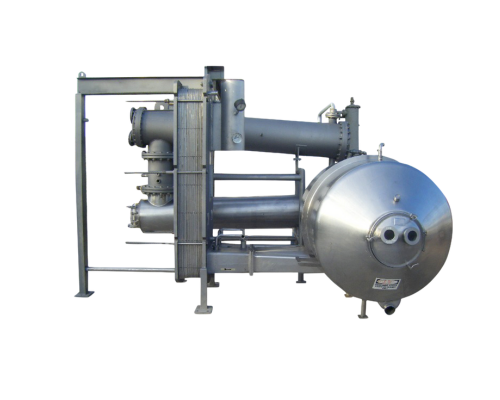
Image from Genemco
Link to Plate-Fin Heat Exchangers
A Quick Look at Plate-Fin Heat Exchangers
A plate-fin heat exchanger consists of alternating layers of plates and corrugated fins.
The plates keep the individual process streams separated, while the fins create flow passages and dramatically increase the available surface area for heat transfer.
Think of it as taking a lot of heat-transfer surface and packing it into a compact block.
Depending on the design, a plate-fin exchanger can accommodate multiple streams within the same core. That can allow engineers to combine several heat-transfer duties into one piece of equipment.
For petrochemical and oil and gas applications, that can be a big advantage.
Space isn't always easy to come by in a refinery, gas plant, offshore facility, or processing unit. If you can accomplish the required heat transfer with a smaller piece of equipment, that's worth considering.
Where Are Plate-Fin Heat Exchangers Used in Oil & Gas?
There isn't one specific "plate-fin application" in the petroleum industry.
Instead, the technology can be used throughout different parts of the process where controlled heating, cooling, condensation, or heat recovery are required.
Let's look at a few of the applications where they can make sense.
Natural Gas Processing
Natural gas coming out of a well isn't necessarily ready to head straight into a pipeline or LNG facility.
Depending on its source, the gas can contain water, heavier hydrocarbons, carbon dioxide, nitrogen, and other components that need to be removed or separated.
Temperature control is an important part of many of those processes.
Plate-fin heat exchangers can be used to cool natural gas, recover heat between process streams, and provide the thermal conditions needed for certain separation processes.
In some gas-processing applications, the ability to handle multiple streams in a compact exchanger can help simplify the overall thermal arrangement.
And when a facility is running continuously, recovering heat from one stream and putting it to work somewhere else can be more than an efficiency improvement—it can become a meaningful operating advantage.
LNG and Cryogenic Gas Processing
When natural gas needs to be liquefied, things get considerably colder.
LNG stands for Liquefied Natural Gas.
Natural gas is cooled to approximately -260°F (-162°C) so that it changes from a gas into a liquid. Because the liquid takes up far less volume than the gas, LNG can be stored and transported economically by ship.
Getting natural gas down to those temperatures requires carefully engineered refrigeration and heat-transfer systems.
Plate-fin heat exchangers can be used in LNG and cryogenic applications to transfer heat between natural gas, refrigerant, and other process streams.
Their compact design and ability to handle multiple streams make them particularly useful when engineers need to squeeze a significant amount of heat transfer into a relatively small package.
In cryogenic processing, the exchanger isn't just cooling something.
It's often recovering cold energy and moving it where it's needed next.
Gas Cooling and Gas-to-Gas Heat Recovery
Oil and gas facilities handle an enormous amount of process gas.
That gas may need to be cooled before entering another stage of the process—or warmed before being sent somewhere else.
A plate-fin heat exchanger can allow one gas stream to exchange heat with another without the two streams mixing.
For example, a hot gas leaving a process could transfer heat to a colder incoming gas stream.
Instead of generating additional heat for the incoming stream and then separately cooling the outgoing stream, the two can potentially help each other.
That's the basic idea behind heat recovery.
You're taking energy that already exists within the process and finding another place for it to do useful work.
NGL Recovery
NGL stands for Natural Gas Liquids.
NGLs include valuable hydrocarbons such as ethane, propane, butanes, and natural gasoline.
Recovering these components from natural gas is an important part of many gas-processing operations.
Temperature control is critical because cooling the gas can help condense and separate heavier hydrocarbons.
Plate-fin heat exchangers can be incorporated into NGL recovery systems to provide cooling and heat recovery between process streams.
In cryogenic NGL recovery applications, the exchanger may be part of a larger system that uses very low temperatures to increase hydrocarbon recovery.
Again, the heat exchanger isn't performing the separation by itself.
It's helping create the temperature conditions that make the separation possible.
Refining: Heating, Cooling and Everything In Between
Refineries are essentially giant heat-management systems.
Crude oil enters the facility and goes through a series of heating, separation, cooling, and conversion processes to produce different petroleum products.
Heat exchangers are used throughout the refinery to transfer energy between process streams.
Plate-fin exchangers may be considered for applications involving:
- Process gas cooling
- Heat recovery
- Air or gas cooling
- Condensation
- Hydrocarbon processing
- Cryogenic service
- Gas separation
- Specialized process heating and cooling
That doesn't mean plate-fin technology replaces the traditional shell-and-tube exchanger.
Far from it.
Shell-and-tube equipment remains extremely common in refinery service because it can handle many demanding applications and is familiar to engineers and maintenance teams.
Plate-fin technology simply gives engineers another tool when compactness, high surface-area density, or multi-stream heat transfer are priorities.
Petrochemical Processing
Petrochemical facilities take hydrocarbons and turn them into the building blocks used to manufacture countless everyday products.
Plastics. Packaging. Synthetic fibers. Solvents. Resins. Chemicals. Industrial materials.
Behind those products are complex processes that require precise temperature control.
Plate-fin heat exchangers can be used in petrochemical facilities for process cooling, heating, condensation, gas processing, and heat recovery.
They're particularly interesting when several process streams need to exchange heat or when a facility is trying to maximize energy recovery while keeping equipment compact.
In a modern process plant, every opportunity to reuse energy can be worth investigating.
Offshore Oil & Gas: When Space Is at a Premium
One of the biggest advantages of compact heat-exchanger technology becomes even more obvious offshore.
On a land-based facility, adding another few feet of equipment may be inconvenient.
On an offshore platform, space and weight can become engineering constraints.
Equipment has to be transported offshore, installed within a defined footprint, and supported by a structure designed around weight and load limitations.
That makes compact equipment particularly attractive when it can meet the process requirements.
Plate-fin heat exchangers can offer a high amount of heat-transfer surface within a relatively small and lightweight package, making them worth considering for certain offshore and floating applications.
Of course, the specific design still has to meet the pressure, temperature, material, safety, and process requirements of the application.
Why Use a Plate-Fin Heat Exchanger Instead of a Shell & Tube?
This isn't really a question of which heat exchanger is better.
It's a question of which one makes sense for the job.
Shell-and-tube heat exchangers have a long history in oil and gas because they're rugged, versatile, and well understood.
Plate-fin heat exchangers can offer advantages when:
- Equipment footprint is limited
- High heat-transfer surface area is desirable
- Multiple streams need to exchange heat
- Gas-to-gas heat transfer is required
- Close temperature approaches are important
- Low-temperature or cryogenic service is involved
- Weight is an important consideration
On the other hand, shell-and-tube designs can have advantages in applications where fouling, mechanical cleaning, extreme pressures, or more conventional maintenance practices are major considerations.
The right answer depends on the process.
The Part Nobody Likes Talking About: Lead Times
Engineers can design a beautiful system on paper.
Then reality shows up.
A piece of equipment fails. Production needs to increase. A project gets moved forward. A customer needs equipment now.
And suddenly the six-month lead time for a new heat exchanger isn't looking quite as convenient.
This is where the pre-owned equipment market can provide another option.
A used plate-fin heat exchanger may provide a temporary solution while a new unit is being manufactured. In other cases, it may be considered as a replacement or supplemental piece of equipment.
The point isn't that used equipment should replace every new equipment purchase.
It shouldn't.
The point is that sometimes you need a bridge.
And that bridge can be the difference between keeping a process moving and shutting down while everyone waits.
Why Choose Genemco?
At Genemco, we've been in the pre-owned industrial equipment business long enough to understand that customers aren't simply buying equipment.
They're trying to solve problems.
Maybe a heat exchanger failed.
Maybe a project has been accelerated.
Maybe the new equipment has a long lead time.
Maybe the customer needs temporary capacity.
Or maybe the right piece of equipment happens to already exist somewhere instead of needing to be manufactured from scratch.
Genemco specializes in buying, selling, and appraising pre-owned industrial refrigeration and food processing equipment.
Our large inventory and experience with industrial equipment give customers another resource when they're looking for equipment outside of the traditional new-equipment route.
For a specialized piece of equipment such as a plate-fin heat exchanger, we'll help you explore what's available and determine whether a pre-owned option may fit your needs.
Sometimes "available now" is its own specification.
OEMs: We Don't Want to Take Your Sale
If you're an OEM, this part is important.
We're not here to compete with you.
If you've sold your customer a new heat exchanger, refrigeration system, processing system, or other piece of equipment, we want you to remain the person who solves their long-term problem.
The challenge is what happens between now and then.
If your new equipment has a long lead time, your customer still has a plant to operate.
That's where Genemco can potentially help.
Think of us as the bandaid that helps your customer get through the short-term problem.
And if it's a bigger emergency?
Maybe we're the tourniquet that keeps the operation running until your permanent equipment arrives.
You made the sale.
You provide the long-term solution.
We help fill the gap.
We want to make you the hero.
Instead of your customer remembering that they had to wait months for their equipment, they can remember that their OEM found a way to help them keep running.
And when the new equipment arrives, your permanent solution takes its place as planned.
That's the relationship we're looking for with OEMs:
You solve the long-term problem. Genemco helps with the "right now" problem.
Image from Genemco
Link to Plate-Fin Heat Exchangers
Keep the Process Moving
The oil and gas and petrochemical industries don't have much room for unnecessary downtime.
A refinery doesn't stop being a refinery because a heat exchanger failed.
A gas-processing facility doesn't stop needing to process gas because the replacement equipment is still being fabricated.
And an offshore operation certainly doesn't have the luxury of unlimited time and space.
Plate-fin heat exchangers can provide an efficient, compact option for applications ranging from gas cooling and heat recovery to natural gas processing, NGL recovery, LNG, and cryogenic service.
And when a new unit is the right long-term answer but the operation needs help getting through the waiting period, Genemco can help explore the pre-owned equipment option.
Because sometimes the best equipment solution isn't simply the newest one.
Sometimes it's the one that can keep the process running until the new one arrives.


