

The dairy industry has always been built on consistency.
Whether it's the gallon of milk in your refrigerator, the yogurt in a lunchbox, or the butter used by a commercial bakery, consumers expect every product to look, taste, and perform exactly the same every single time. Behind that consistency is a carefully controlled production process where temperature plays a leading role.
From the moment raw milk enters a processing facility until the finished product is packaged, heating and cooling are happening almost continuously. Every degree matters. Too much heat can affect flavor and nutritional quality, while insufficient cooling can impact product safety, shelf life, or downstream processing.
That's where industrial heat exchangers become indispensable.
While plate heat exchangers are often the first technology associated with dairy processing, tube-in-tube heat exchangers continue to provide reliable performance for a variety of applications throughout dairy plants. Their straightforward design, ability to handle products with varying viscosities, and dependable operation make them a practical solution for processors looking to maintain product quality while keeping production moving.
Let's explore how tube-in-tube heat exchangers contribute to today's dairy industry and why many processors continue to rely on them.
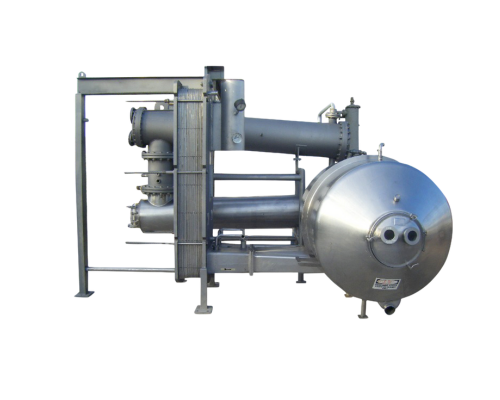
Image from Genemco
Link to Tube-in-Tube Heat Exchangers
The Importance of Temperature Control in Dairy Production
Dairy products are constantly changing throughout production.
Milk is heated, cooled, separated, blended, concentrated, cultured, or churned depending on the final product being produced. Every one of those steps requires carefully controlled temperatures to achieve the desired texture, flavor, consistency, and shelf life.
For dairy processors, temperature control isn't simply about efficiency—it's about producing a product consumers trust every day.
Tube-in-tube heat exchangers help processors manage those temperature changes while supporting reliable, continuous production.
How Tube-in-Tube Heat Exchangers Work
A tube-in-tube heat exchanger uses two concentric tubes to transfer heat between separate fluids.
The dairy product typically flows through the inner tube while a heating or cooling medium flows through the surrounding outer tube. Heat transfers through the tube wall without the fluids ever coming into contact.
This simple yet effective design allows processors to heat or cool products while maintaining sanitary processing conditions and product integrity.
Because tube-in-tube heat exchangers often feature relatively open flow passages, they can be well suited for dairy products that are thicker or more viscous than water, making them a valuable option for many processing applications.
Milk Heating and Cooling
Milk processing begins with precise temperature management.
After collection, milk is rapidly cooled to preserve freshness before undergoing additional processing steps. Later, it may be heated for pasteurization, ingredient preparation, or other production stages before being cooled again for storage or packaging.
Tube-in-tube heat exchangers may be used to:
- Cool raw milk after receiving
- Warm milk prior to processing
- Support intermediate heating and cooling steps
- Maintain controlled transfer temperatures
- Improve overall production efficiency
Maintaining consistent temperatures throughout the process helps preserve product quality while supporting efficient plant operations.
Cream Processing
Cream processing requires careful handling to preserve texture, fat content, and overall product quality.
Throughout production, cream may be heated, cooled, blended, or conditioned before moving into additional manufacturing steps.
Tube-in-tube heat exchangers help processors maintain stable product temperatures that support smooth processing while reducing unnecessary thermal stress on the product.
Cheese Manufacturing
Cheese production involves numerous carefully controlled stages where temperature influences everything from curd formation to whey separation.
Tube-in-tube heat exchangers can assist with:
- Ingredient conditioning
- Milk preparation
- Process temperature control
- Cooling intermediate products
- Supporting downstream manufacturing operations
Because every cheese variety has unique processing requirements, dependable temperature control helps manufacturers consistently produce the characteristics consumers expect.
Whey Processing
Once considered a byproduct, whey has become one of the dairy industry's most valuable ingredients.
Today, whey is processed into products used for nutritional beverages, protein supplements, sports nutrition, infant formula, and countless food applications.
Tube-in-tube heat exchangers help processors manage temperatures during various stages of whey concentration, ingredient preparation, and product handling.
Reliable heat transfer supports efficient production while helping maintain the functional properties that make whey such a versatile ingredient.
Yogurt Production
Making yogurt is both a science and an art.
Milk must be heated, cooled, inoculated with cultures, and maintained within carefully controlled temperature ranges to achieve the proper fermentation process.
Tube-in-tube heat exchangers may be used to prepare dairy ingredients before culturing, cool products between processing stages, or condition ingredients throughout production.
Consistent temperature control contributes to uniform texture, flavor development, and product quality from batch to batch.
Ice Cream Ingredient Preparation
Ice cream begins long before freezing.
Milk, cream, sugar, stabilizers, emulsifiers, and flavorings must be blended and conditioned into a smooth mix before entering freezers and other downstream equipment.
Tube-in-tube heat exchangers help processors:
- Warm ingredients before blending
- Cool prepared mixes
- Maintain process temperatures during transfer
- Support efficient production scheduling
By conditioning ingredients before freezing, manufacturers help ensure a consistent foundation for the finished product.
Butter Processing
Butter production depends on carefully controlled temperatures throughout cream preparation and churning.
Proper temperature management influences:
- Churning efficiency
- Moisture distribution
- Product consistency
- Texture
- Finished product quality
Tube-in-tube heat exchangers can help maintain those processing temperatures while supporting efficient movement of cream throughout production.
Why Dairy Processors Continue to Use Tube-in-Tube Heat Exchangers
In an industry where production often runs around the clock, equipment reliability matters just as much as processing performance.
Tube-in-tube heat exchangers continue to be a trusted solution because they offer several practical advantages:
- Durable industrial construction
- Straightforward operation
- Reliable heat transfer performance
- Suitable for products with moderate viscosity
- Long operating life
- Simplified maintenance compared to more complex systems
- Flexible integration into existing processing lines
- Consistent performance in continuous production environments
Sometimes, the best equipment isn't necessarily the newest design—it's the one that performs reliably shift after shift.
Why Dairy Processors Turn to Genemco
Every dairy processor understands how costly downtime can become.
A delayed shipment of milk, an unexpected equipment failure, or a production bottleneck can quickly ripple through an entire facility. Lost production time often means missed delivery schedules, wasted product, and unnecessary expenses.
That's why Genemco has spent decades helping processors find dependable industrial refrigeration and food processing equipment when they need it most.
With one of the industry's largest inventories of quality used equipment, many units are available for immediate shipment—helping processors reduce downtime, expand production capacity, or replace aging equipment without waiting months for new manufacturing.
When you work with Genemco, you benefit from:
- A large inventory of quality used food processing equipment
- Equipment available for quick shipment
- Experienced equipment specialists who understand processing applications
- Inspection and testing services on many applicable units
- Global shipping capabilities
- Decades of experience serving the dairy, food processing, and industrial refrigeration industries
Our goal isn't simply to sell equipment—it's to help keep your production line moving.
Image from Genemco
Link to Tube-in-Tube Heat Exchangers
Helping OEMs Deliver for Their Customers
Strong partnerships help move the dairy industry forward, and that includes the relationships between processors, OEMs, and equipment suppliers.
At Genemco, we don't view ourselves as competing with OEMs. In fact, we often work alongside them to help customers navigate unexpected challenges.
Imagine you've sold a new tube-in-tube heat exchanger or an entire processing system, but current manufacturing schedules mean your customer won't receive it for several months. Meanwhile, their existing equipment has failed, and production can't stop.
Rather than watching your customer struggle through extended downtime, consider Genemco as a temporary solution.
You remain the trusted partner who delivered the long-term equipment solution, while we help bridge the gap with quality used equipment that's available now. Think of it as a temporary support system—a bandage for a manageable problem or, when the situation is more urgent, a tourniquet that helps stabilize operations until the permanent solution arrives.
When the new equipment is installed, your customer remembers that you found a way to keep their facility running instead of simply asking them to wait.
To us, that's what partnership looks like. We help protect your customer relationships while keeping dairy production moving.
Final Thoughts
The dairy industry depends on precision, consistency, and dependable equipment. Every stage of production—from milk receiving and cream processing to cheese manufacturing, whey processing, yogurt production, ice cream mix preparation, and butter processing—relies on carefully managed temperatures to produce safe, high-quality products.
Tube-in-tube heat exchangers continue to play an important role because they combine reliable performance with a practical, durable design that fits a wide variety of dairy processing applications.
Whether you're upgrading an existing production line, replacing a failed heat exchanger, expanding capacity, or simply looking for a reliable interim solution while new equipment is being built, Genemco is ready to help.
Because in dairy processing, every hour of uptime matters—and having the right equipment partner can make all the difference.


