

Chemical processing plants don’t operate in a gentle environment.
They deal with corrosive materials, aggressive reaction conditions, strict temperature control requirements, and continuous production schedules that often run 24/7. A single interruption in heat transfer can impact product quality, safety, yield, and downstream processes.
That’s why, even with decades of technological advancement in process equipment, shell & tube heat exchangers remain one of the most widely used and trusted solutions in the chemical industry.
They’re not the newest option on the market — but they are one of the most proven.
And in chemical processing, “proven” carries a lot of weight.
What Is a Shell & Tube Heat Exchanger?
A shell & tube heat exchanger is a mechanical device designed to transfer heat between two fluids without allowing them to mix.
The basic structure includes:
- A cylindrical outer shell
- A bundle of internal tubes
- One fluid flowing through the tubes
- A second fluid flowing around the tubes inside the shell
As the fluids pass through the exchanger, heat is transferred efficiently between them.
What makes this design especially valuable in chemical processing is its ability to be engineered for:
- High temperatures
- High pressures
- Corrosive media
- Continuous operation
- Variable process conditions
It’s a workhorse design that can be adapted to a wide range of demanding chemical applications.
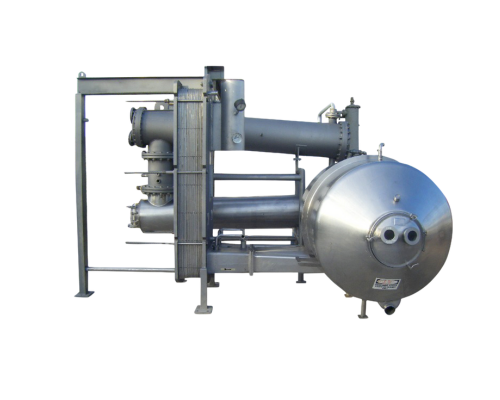
Image from Genemco
Link to Shell & Tube Heat Exchangers
Why Chemical Plants Rely on Shell & Tube Heat Exchangers
Chemical manufacturing is fundamentally about controlled reactions.
And those reactions depend heavily on precise temperature management.
If temperatures drift too high or too low, you’re not just dealing with inefficiency — you’re potentially dealing with:
- Reduced yield
- Off-spec product
- Safety risks
- Equipment stress
- Process instability
Shell & tube heat exchangers help keep those variables in check by supporting controlled heating and cooling throughout the process.
Common Applications in Chemical Processing
Reactor Temperature Control
Chemical reactors often require continuous cooling or heating to maintain stable reaction conditions.
Shell & tube heat exchangers are commonly used to:
- Remove excess reaction heat
- Maintain optimal reaction temperatures
- Prevent thermal runaway conditions
- Stabilize batch and continuous processes
In many plants, reactor temperature control is one of the most critical uses of heat exchange equipment.
Condensing and Vapor Recovery
Chemical processes frequently involve vapor phases that must be condensed and recovered.
Shell & tube exchangers are used for:
- Vapor condensation
- Solvent recovery systems
- Emissions control support
- Process efficiency improvement
These systems help reduce waste while improving operational efficiency.
Utility and Cooling Water Systems
Most chemical plants rely on centralized utility systems that support multiple processes.
Shell & tube heat exchangers help manage:
- Cooling water loops
- Glycol systems
- Chilled water distribution
- Heat rejection systems
Because these systems support the entire plant, reliability is critical.
Heat Recovery Applications
Energy efficiency is a major focus in chemical processing.
Shell & tube exchangers are often used for:
- Waste heat recovery
- Preheating process streams
- Energy reuse systems
- Thermal optimization between process stages
This helps reduce operating costs while improving overall plant efficiency.
Corrosive Fluid Handling
Chemical plants often deal with aggressive or corrosive materials.
Shell & tube exchangers can be built with:
- Specialized alloys
- Corrosion-resistant tube materials
- Protective coatings
- Custom configurations for harsh media
This flexibility makes them suitable for a wide range of chemical environments.
Why Shell & Tube Heat Exchangers Remain a Standard in Chemical Facilities
Even with compact and high-efficiency alternatives available, shell & tube exchangers remain a staple because they are:
- Highly adaptable to different chemical processes
- Capable of handling extreme conditions
- Easier to service and mechanically clean in many cases
- Familiar to plant engineers and maintenance teams
- Proven over decades of industrial use
- Scalable for large process systems
In an industry where downtime and failure carry real consequences, predictable performance is often more valuable than theoretical efficiency gains.
The Reality: When Equipment Fails or Lead Times Stretch
Chemical processing doesn’t pause for equipment delays.
If a critical heat exchanger goes down, the ripple effect can impact:
- Entire production lines
- Batch schedules
- Raw material utilization
- Energy consumption
- Plant throughput
And when replacement equipment lead times stretch into weeks or months, plants are often forced into difficult decisions.
That’s where Genemco can play a practical supporting role for many facilities, engineering firms, and OEM partners.
Supporting OEMs Without Disrupting the Sale
There’s an important reality in industrial equipment sales: OEMs and suppliers invest significant time and expertise into designing and delivering the right solution for their customers.
Genemco is not trying to interfere with that process.
In fact, in many cases, Genemco helps strengthen it.
Here’s how that typically plays out:
An OEM secures a sale for a new shell & tube heat exchanger system. Everything is aligned — specifications, engineering, and customer approval. But manufacturing lead times are long, and the customer has an immediate operational challenge.
Rather than letting that gap become a crisis, Genemco may be able to step in with a temporary solution using available used or surplus equipment.
It’s not about replacing the OEM’s solution.
It’s about protecting the customer’s operation in the meantime.
Think of it as:
- A temporary bridge between failure and full replacement
- A stopgap solution to protect production continuity
- A bandaid in the short term
- Or even a tourniquet when the situation is urgent and uptime is critical
From the customer’s point of view, the experience changes dramatically. Instead of “we’ll have to wait,” they see a team working together to keep their plant running.
And in that moment, the OEM becomes the hero — not just the supplier of equipment, but the partner who helped solve a real operational problem.
Why Chemical Processing Facilities Work with Genemco
Genemco’s equipment inventory includes a wide range of industrial refrigeration, process, and heat transfer equipment used across chemical, food, energy, and manufacturing industries.
Facilities and engineering teams often turn to Genemco because of:
- Broad inventory of available equipment
- Faster access compared to new manufacturing lead times
- Cost-effective alternatives for urgent needs
- Experience with industrial process systems
- Support for emergency replacements
- Equipment sourcing and procurement expertise
- Understanding of heavy industrial environments
When production is on the line, speed and availability can be just as important as specifications.
Image from Genemco
Link to Shell & Tube Heat Exchangers
Final Thoughts
Chemical processing facilities depend on controlled heat transfer to maintain safe, efficient, and consistent operations.
That’s why shell & tube heat exchangers continue to be a foundational part of the industry. Their flexibility, durability, and proven performance make them a reliable solution for reactor control, condensation, utilities, and heat recovery systems across a wide range of chemical applications.
And when unexpected failures or extended equipment lead times threaten production continuity, companies like Genemco help bridge the gap — supporting OEMs, engineers, and plant operators in keeping operations moving while long-term solutions are delivered.


