

The chemical processing industry isn't forgiving.
Unlike many manufacturing environments, chemical facilities routinely operate with elevated temperatures, varying pressures, corrosive media, and tightly controlled process conditions. A slight change in temperature can influence reaction rates, product quality, equipment performance, or even plant efficiency.
For engineers and operators, consistency isn't simply desirable—it's essential.
That's one reason heat exchangers are found throughout virtually every chemical processing facility. They quietly manage temperatures behind the scenes, helping reactions proceed as intended while protecting equipment and improving overall process stability.
Among the many heat exchanger designs available today, tube-in-tube heat exchangers continue to be a dependable choice for a variety of chemical processing applications. Their straightforward construction, durability, and versatility make them well suited for facilities that value reliability just as much as performance.
Let's take a closer look at where tube-in-tube heat exchangers fit into chemical manufacturing and why they remain a trusted solution across the industry.
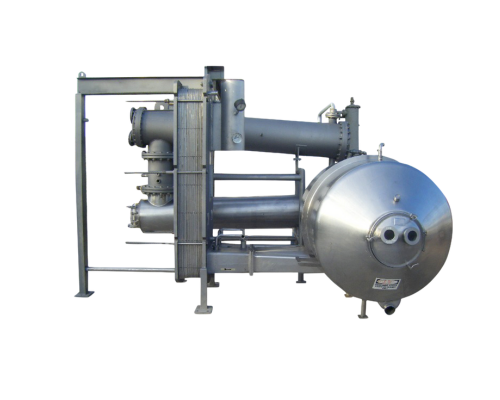
Image from Genemco
Link to Tube-in-Tube Heat Exchangers
The Role of Heat Transfer in Chemical Processing
Chemical manufacturing is a series of carefully controlled reactions.
Some reactions generate heat that must be removed quickly. Others require precise heating before ingredients can react properly. Many production lines alternate between heating and cooling multiple times before the finished product is complete.
Without dependable heat transfer, maintaining those process conditions becomes significantly more difficult.
Tube-in-tube heat exchangers help facilities move thermal energy where it's needed—and remove it where it isn't—allowing production systems to operate more predictably and efficiently.
How Tube-in-Tube Heat Exchangers Work
The concept behind a tube-in-tube heat exchanger is remarkably simple.
One process fluid flows through an inner tube while a second heating or cooling medium flows through the surrounding outer tube. Heat transfers through the wall separating the two fluids without allowing them to mix.
That simplicity is part of what makes this design so valuable in industrial settings.
With relatively few moving parts and a rugged construction, tube-in-tube heat exchangers can provide dependable service in applications where reliability is every bit as important as thermal performance.
Chemical Reactors
Many chemical reactions either release heat (exothermic) or require heat to continue (endothermic).
Maintaining the correct reactor temperature is critical for controlling reaction rates, maximizing product yield, and producing consistent results.
Tube-in-tube heat exchangers may be used within reactor support systems to:
- Condition incoming process fluids
- Remove excess reaction heat
- Preheat raw materials
- Maintain stable reactor temperatures
- Support continuous production processes
Reliable temperature control helps operators maintain tighter process control throughout the manufacturing cycle.
Solvent Recovery
Recovering and reusing solvents has become increasingly important for both economic and environmental reasons.
Many chemical manufacturers recover valuable solvents through processes that rely on controlled heating and cooling.
Tube-in-tube heat exchangers can help transfer thermal energy during solvent recovery operations by cooling recovered solvents or conditioning process streams before additional separation steps.
Efficient solvent recovery can reduce operating costs while improving overall resource utilization.
Process Heating
Not every process begins at the desired temperature.
Many raw materials require heating before mixing, pumping, blending, or reacting with other ingredients.
Tube-in-tube heat exchangers are commonly used to raise process fluid temperatures in preparation for downstream operations.
By delivering controlled, repeatable heating, manufacturers can improve process consistency while reducing unnecessary thermal stress on sensitive materials.
Cooling Loops
Removing excess heat is just as important as adding it.
Chemical plants often operate dedicated cooling loops that circulate cooling water, glycol, or other heat transfer fluids throughout the facility.
Tube-in-tube heat exchangers help transfer unwanted heat away from equipment and process streams, supporting:
- Stable operating temperatures
- Equipment protection
- Process consistency
- Continuous production
- Improved energy management
Reliable cooling contributes to smoother plant operations while helping extend equipment life.
Specialty Chemical Manufacturing
Specialty chemicals often involve smaller production batches, unique formulations, and tightly controlled manufacturing parameters.
Products such as industrial coatings, additives, catalysts, surfactants, and performance chemicals frequently require careful temperature management throughout production.
Tube-in-tube heat exchangers provide dependable thermal control during ingredient preparation, blending, intermediate processing, and product finishing.
Their versatility makes them well suited for facilities producing a diverse range of specialty products.
Polymer Production
Producing polymers involves carefully balancing chemistry, temperature, pressure, and timing.
Whether manufacturing resins, plastics, synthetic materials, or engineered polymers, maintaining consistent thermal conditions helps improve product quality and process repeatability.
Tube-in-tube heat exchangers may support polymer production by:
- Conditioning feed materials
- Managing reaction temperatures
- Cooling intermediate products
- Preparing materials for downstream processing
- Supporting continuous manufacturing systems
Consistent heat transfer contributes to more predictable production and dependable product quality.
Why Chemical Manufacturers Continue to Use Tube-in-Tube Heat Exchangers
Chemical plants often expect equipment to perform under demanding conditions for years.
That expectation makes reliability a major factor when selecting heat transfer equipment.
Tube-in-tube heat exchangers continue to be widely used because they offer:
- Rugged industrial construction
- Reliable heat transfer performance
- Straightforward maintenance
- Long operating life
- Flexible installation options
- Compatibility with a wide range of industrial fluids
- Dependable operation in continuous processing environments
- Adaptability for heating and cooling applications
Sometimes proven technology remains the best solution because it consistently delivers dependable results.
Why Chemical Processors Choose Genemco
In chemical manufacturing, production schedules are carefully planned—but equipment failures rarely follow the schedule.
When a heat exchanger unexpectedly needs replacement, waiting several months for new equipment may not be practical. Every day of downtime can affect production commitments, customer deliveries, and operating efficiency.
That's where Genemco can make a difference.
For decades, we've helped industrial processors source quality used processing and industrial refrigeration equipment that helps facilities return to operation faster.
Our inventory often includes heat exchangers and other critical process equipment that are available for prompt shipment, allowing customers to minimize downtime and maintain production continuity whenever possible.
Working with Genemco provides access to:
- One of the industry's largest inventories of quality used industrial processing equipment
- Equipment ready to ship in many cases
- Experienced specialists who understand industrial processing applications
- Inspection and testing services on many applicable units
- Worldwide shipping capabilities
- Decades of experience serving chemical, food, beverage, pharmaceutical, and industrial refrigeration industries
Our mission has always been to help processors keep their operations running efficiently while finding practical equipment solutions that fit both their process and their timeline.
Image from Genemco
Link to Tube-in-Tube Heat Exchangers
Helping OEMs Protect Customer Relationships
The best partnerships are built on solving problems together.
At Genemco, we recognize the value OEMs bring to the chemical processing industry through innovation, engineering expertise, and long-term equipment solutions. We have no interest in replacing those relationships.
Instead, we'd like to strengthen them.
Imagine you've worked closely with a chemical manufacturer, designed the right equipment package, and secured the order. The only obstacle is a manufacturing lead time that stretches several months into the future.
Then an unexpected equipment failure changes everything.
Your customer can't afford to idle production while waiting for the permanent replacement to arrive.
That's where Genemco can help.
Think of us like a temporary bypass lane during highway construction. The destination hasn't changed, and the permanent roadway is still being built. Our role is simply to keep traffic moving until the new route is ready.
By providing quality used equipment that can often ship quickly, we help your customer stay operational while reinforcing the confidence they've already placed in you.
When your new equipment is installed, you're still the partner who delivered the long-term solution—and your customer remembers that you found a way to keep their operation moving during a challenging time.
That's the kind of partnership we believe benefits everyone involved.
Final Thoughts
Chemical processing demands equipment that performs consistently under challenging operating conditions. From chemical reactors and solvent recovery systems to process heating, cooling loops, specialty chemical production, and polymer manufacturing, tube-in-tube heat exchangers continue to provide dependable heat transfer where precision and reliability matter most.
Whether you're replacing aging equipment, expanding production capacity, modernizing an existing process, or searching for an interim solution while waiting for new equipment to arrive, Genemco is ready to help. Because in chemical processing, success isn't just about controlling reactions—it's about keeping the entire operation moving safely, efficiently, and without unnecessary interruption.


