

When you work around industrial refrigeration and food processing equipment, you quickly learn that not every heat exchanger is built for the same job. Some applications call for a traditional shell-and-tube design. Others are better suited for a gasketed plate heat exchanger, a scraped surface heat exchanger, or a tube-in-tube exchanger.
And then there are applications where space is limited, temperature differences are tight, multiple process streams need to be handled, or gas-to-gas heat transfer is involved. That's where plate-fin heat exchangers can really stand out.
Plate-fin heat exchangers are a type of compact heat exchanger designed to put a tremendous amount of heat transfer surface into a relatively small package. They are especially common in cryogenic, natural gas, chemical, refrigeration, and other process applications where efficiency, compactness, and precise thermal performance matter.
Image from Genemco
Link to Plate-Fin Heat Exchangers
What Is a Plate-Fin Heat Exchanger?
At first glance, a plate-fin heat exchanger may look fairly simple: layers of metal plates and corrugated fins are stacked together and brazed to create a compact block, or "core."
But what's happening inside is considerably more sophisticated.
The flat plates, sometimes called parting sheets, separate the individual fluid streams. Between those plates are corrugated fins that create numerous small flow passages. The fins dramatically increase the available heat-transfer surface area while also helping give the exchanger its structural strength. In many brazed-aluminum designs, the entire core is vacuum brazed into a sealed, rigid assembly.
Instead of having two large passages with relatively limited surface area, a plate-fin exchanger essentially packs many small heat-transfer passages into one compact block.
That design allows plate-fin heat exchangers to achieve very high heat-transfer performance without requiring the footprint of a much larger conventional exchanger.
Another major advantage is flexibility. Depending on the design, plate-fin exchangers can accommodate counterflow, crossflow, parallel flow, and even multiple streams within the same exchanger. Multi-stream capability is particularly valuable in complex process and cryogenic systems.
Why Use a Plate-Fin Heat Exchanger?
The biggest reason is simple:
You can get a lot of heat transfer in a surprisingly small package.
The finned construction creates an extremely high heat-transfer area relative to the volume of the exchanger. That can translate into a smaller footprint, lower equipment weight, and excellent thermal performance.
Depending on the design and application, plate-fin heat exchangers can offer:
- High heat-transfer efficiency
- Compact footprint
- High surface-area-to-volume ratio
- Low temperature approaches
- Low pressure drop in appropriately designed applications
- Multi-stream heat transfer
- Gas-to-gas and gas-to-liquid capabilities
- Excellent performance at low and cryogenic temperatures
- Reduced equipment weight compared with some conventional designs
For example, brazed-aluminum plate-fin heat exchangers are widely used in cryogenic applications because aluminum performs well at extremely low temperatures and allows designers to achieve very close temperature approaches.
That makes them particularly attractive when simply "making the equipment bigger" isn't a practical solution.
What Industries Use Plate-Fin Heat Exchangers?
Plate-fin heat exchangers can be found across a wide range of industries, but they are particularly valuable where compactness, thermal efficiency, low temperatures, or multiple process streams are important.
Natural Gas & LNG
Natural gas processing and liquefaction are some of the best-known applications for brazed-aluminum plate-fin heat exchangers.
They can be used for applications such as:
- Natural gas processing
- LNG liquefaction
- NGL recovery
- Nitrogen rejection
- Gas cooling
- Gas-to-gas heat recovery
Their compact design and ability to handle cryogenic temperatures make them well suited to these applications.
Cryogenic & Industrial Gas
Plate-fin heat exchangers are a major component in cryogenic processing, including:
- Air separation
- Oxygen production
- Nitrogen production
- Hydrogen processing
- Helium recovery and liquefaction
- Liquefied gas processing
In these systems, the ability to transfer heat between multiple streams while maintaining very close temperature approaches can be extremely valuable.
Chemical Processing
Chemical plants use plate-fin heat exchangers for process cooling, heating, heat recovery, and gas processing.
They can be particularly useful where a process involves multiple streams or where reducing equipment footprint is important.
Petrochemical & Oil and Gas
Plate-fin technology is used throughout petrochemical and gas-processing facilities, including low-temperature processing and gas treatment.
Linde, for example, identifies petrochemical and gas-treatment facilities among the applications for its plate-fin heat exchangers.
Industrial Refrigeration
Plate-fin heat exchangers can also play an important role in industrial refrigeration applications where compact equipment, low refrigerant charge, tight temperature approaches, or gas-to-gas and gas-to-liquid heat transfer are important.
Brazed plate-and-fin designs are specifically used in large-scale refrigeration systems and can provide a compact footprint and low refrigerant charge.
Food & Beverage Processing
While traditional plate heat exchangers are extremely common in food and beverage processing, plate-fin technology can be appropriate for certain specialized applications—particularly where gas streams, compact heat recovery, or specialized process conditions are involved.
The important distinction is that plate-fin doesn't automatically mean "better." The right exchanger depends on the product, fluid properties, temperature, pressure, sanitation requirements, fouling potential, and cleaning requirements.
And that's true across virtually every heat-transfer application.
Aerospace & Transportation
The compact and lightweight nature of plate-fin heat exchangers makes them attractive in aerospace and transportation applications where every pound and every inch of available space matters. Plate-fin technology has been used for applications including aircraft environmental-control and engine cooling systems.
Plate-Fin vs. Other Heat Exchangers
So how does a plate-fin heat exchanger compare with the other heat exchangers you are likely to encounter in an industrial facility?
The answer isn't that one is universally better than the others. They're different tools for different jobs.
Plate-Fin vs. Plate Heat Exchanger
These two are easy to confuse because both use plates—and both can be very compact.
A traditional plate heat exchanger (PHE) generally consists of a stack of corrugated metal plates. The fluids flow through alternating channels, and the corrugations increase turbulence and heat-transfer performance.
They are extremely common in food, dairy, beverage, pharmaceutical, HVAC, and industrial applications. Gasketed designs can also be opened for inspection and cleaning.
A plate-fin heat exchanger, on the other hand, incorporates corrugated fins between the plates. Those fins create additional heat-transfer surface and numerous small flow passages.
Think of it this way:
- Plate heat exchanger: plates create the heat-transfer channels.
- Plate-fin heat exchanger: plates plus fins create a much greater amount of heat-transfer surface within the channels.
Plate heat exchangers are often a great choice for clean liquid-to-liquid applications, particularly where regular cleaning and maintenance are important.
Plate-fin exchangers shine when compactness, very high surface area, low-temperature service, gas processing, or multi-stream configurations become priorities.
One important consideration: the narrow, intricate passages in many plate-fin designs can make them more difficult to clean if fouling occurs.
Plate-Fin vs. Shell & Tube
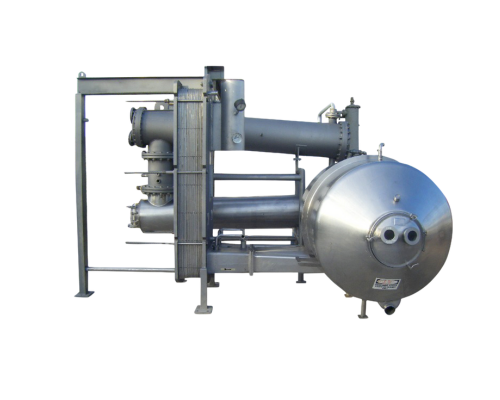
The shell-and-tube heat exchanger is probably the classic workhorse of industrial heat transfer.
It consists of a bundle of tubes contained inside a shell. One fluid travels through the tubes while another flows around the outside of the tubes within the shell.
They're rugged, proven, versatile, and available in a huge range of configurations.
But they can also take up considerably more space.
Plate-fin exchangers can provide comparable heat-transfer capability in a much more compact package, particularly for applications where high surface-area density is advantageous.
Shell & tube often wins when:
- High pressure or temperature is involved
- Fouling is a concern
- Mechanical cleaning is important
- A rugged, conventional design is preferred
Plate-fin often wins when:
- Space is limited
- Weight matters
- Very close temperature approaches are required
- Gas-to-gas or gas-to-liquid heat transfer is involved
- Multiple streams need to be integrated
- Cryogenic temperatures are involved
Again, it's not about one replacing the other. It's about matching the exchanger to the application.
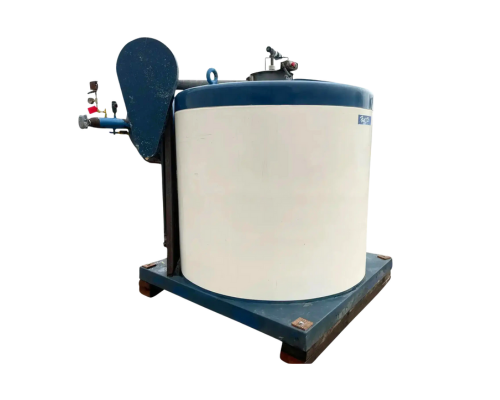
Plate-Fin vs. Votator / Scraped Surface Heat Exchanger
This is a very different comparison.
A Votator or scraped surface heat exchanger (SSHE) is designed for products that can be thick, sticky, viscous, or prone to building up on the heat-transfer surface.
A rotating scraper continuously removes product from the heat-transfer surface, helping maintain heat transfer while reducing product buildup.
That's why scraped surface equipment is commonly associated with applications such as:
- Margarine
- Shortening
- Ice cream
- Sauces
- Creams
- Fillings
- Chocolate
- Other viscous food and industrial products
A plate-fin exchanger isn't designed to mechanically scrape product from its heat-transfer surface.
So if you're processing a product that behaves more like peanut butter than water, you're probably having a very different heat-transfer conversation.
Plate-fin: compact, high-surface-area heat transfer.
Scraped surface: controlled heat transfer for viscous or fouling products.
The application determines the winner.
Plate-Fin vs. Tube-in-Tube
A tube-in-tube heat exchanger is another relatively straightforward design.
One tube is positioned inside another tube, allowing one fluid to travel through the inner tube while the other travels through the surrounding annular space.
Tube-in-tube exchangers are useful for a variety of heating and cooling applications and can be a practical solution when simplicity, accessibility, and certain flow arrangements are important.
Compared with a plate-fin exchanger, however, a tube-in-tube design generally doesn't provide the same extremely high heat-transfer surface area per unit of volume.
Tube-in-tube: simple, practical, versatile.
Plate-fin: highly compact, high surface-area density, and capable of handling complex multi-stream configurations.
Choosing the Right Heat Exchanger Isn't Always About the Newest Technology
This is probably one of the most important points for anyone responsible for industrial equipment:
The "best" heat exchanger is the one that fits the application.
If your process involves a clean liquid and requires frequent cleaning, a gasketed plate heat exchanger may make more sense.
If you're dealing with high pressures and temperatures or a challenging process fluid, a shell-and-tube exchanger may be the better choice.
If you're processing a thick, sticky food product, a scraped surface exchanger may be the right answer.
If you're working with cryogenic gases, multiple process streams, or an application where space is at a premium, a plate-fin heat exchanger may be exactly what you need.
It's all about understanding what you're trying to accomplish—not simply picking a heat exchanger because it looks good on a specification sheet.
Why Consider Genemco for Used Plate-Fin Heat Exchangers?
At Genemco, we understand that industrial equipment doesn't always arrive on the schedule you'd like it to.
A new piece of equipment may have a long manufacturing lead time. A project may be moving faster than the equipment supplier can. A production line may need to stay operational while a permanent replacement is being designed, manufactured, and delivered.
That's where used equipment can make a difference.
Genemco specializes in buying, selling, and appraising pre-owned industrial refrigeration and food processing equipment. Our inventory includes equipment from many of the industries and applications where heat exchangers are used.
When sourcing a used plate-fin heat exchanger, the goal isn't simply to find a heat exchanger. It's to find equipment that makes sense for the application—considering things like size, configuration, materials, pressure rating, connections, capacity, and service history.
And because we're dealing with used industrial equipment, availability can sometimes mean finding a solution that is already sitting in a warehouse instead of waiting months for something to be manufactured.
That's where we can help.
Image from Genemco
Link to Plate-Fin Heat Exchangers
OEMs: We Don't Want to Take Your Sale
If you're an OEM, we understand something very important:
We want to help you make your sale...
Imagine you've sold a customer a new heat exchanger, refrigeration system, processing system, or other piece of equipment—but the new equipment has a long lead time.
Your customer still has production to run.
They still have orders to fill.
And they probably aren't particularly interested in hearing, "You'll have to wait six months."
That's where Genemco can potentially step in.
Think of us as the bandaid—or, when the situation is serious enough, the tourniquet.
We can help your customer find a used piece of equipment to keep the operation moving while they wait for the new equipment to arrive.
You make the sale. You remain the hero. We help bridge the gap.
Once the new equipment is ready, the temporary equipment can be removed and the customer can move forward with the long-term solution you originally sold them.
For OEMs, that can mean less downtime, a happier customer, and a project that keeps moving instead of becoming an emergency.
Keep the Process Moving
In industrial refrigeration and food processing, downtime doesn't politely wait for your new equipment to arrive.
When a critical piece of equipment fails, the question often isn't, "What's the perfect solution five months from now?"
It's:
"How do we keep running right now?"
That's where pre-owned equipment can have a very real place in the industry.
Whether you're looking for a plate-fin heat exchanger, another type of heat exchanger, or equipment to bridge the gap while a new system is being built, Genemco can help you explore what's available.
Because sometimes the smartest solution isn't waiting for the perfect piece of equipment.
Sometimes it's finding the right piece of equipment that's already out there—and getting your operation back to work.


