

In nearly every processing plant, there is one piece of equipment quietly doing one of the most important jobs in the operation—transferring heat. Whether you're cooling a food product, heating ingredients before processing, recovering energy, or maintaining precise temperatures throughout production, heat exchangers are the unsung heroes that help keep operations running efficiently.
While plate heat exchangers often receive much of the attention, industrial tube-in-tube heat exchangers continue to play an important role across a wide range of industries because of their durability, simplicity, and ability to handle demanding process conditions.
Let's take a closer look at what tube-in-tube heat exchangers are, where they're commonly used, how they compare to other heat exchanger designs, and why many processors continue to rely on them decades after installation.
What Is a Tube-in-Tube Heat Exchanger?
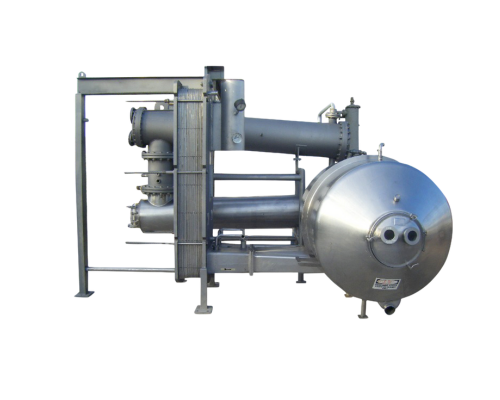
A tube-in-tube heat exchanger, sometimes called a concentric tube heat exchanger, is exactly what its name suggests—a smaller tube installed inside a larger outer tube.
One fluid flows through the inner tube while another flows through the outer annular space surrounding it. As the two fluids travel through the exchanger, heat transfers through the wall of the inner tube without the fluids ever mixing.
Many industrial systems operate these units in counterflow, where the two fluids travel in opposite directions. This configuration maximizes heat transfer efficiency while maintaining excellent temperature control.
Unlike more complex exchanger designs, tube-in-tube units have relatively few components, making them dependable, easy to understand, and well suited for many industrial applications.
Image from Genemco
Link to Tube-in-Tube Heat Exchangers
Industries That Commonly Use Tube-in-Tube Heat Exchangers
Although often associated with refrigeration systems, tube-in-tube heat exchangers are found throughout numerous processing industries.
Food Processing
Food manufacturers frequently use tube-in-tube heat exchangers for:
- Syrups
- Sauces
- Liquid sugars
- Dairy ingredients
- Beverage concentrates
- Liquid eggs
- Oils
- Flavorings
- Chocolate processing
- Fruit purees
Their smooth internal tubing allows products to flow efficiently while maintaining sanitary processing conditions.
Dairy Processing
The dairy industry relies on heat exchangers during numerous production stages, including:
- Milk heating and cooling
- Cream processing
- Cheese manufacturing
- Whey processing
- Yogurt production
- Ice cream ingredients
- Butter processing
Tube-in-tube exchangers can be especially useful when products have higher viscosities than water or require gentle handling.
Beverage Manufacturing
From breweries to juice processors, beverage manufacturers use these exchangers for:
- Wort cooling
- Juice temperature control
- Wine production
- Coffee concentrates
- Tea concentrates
- Soft drink ingredients
- Flavor concentrates
Consistent product temperatures help maintain quality and improve production efficiency.
Industrial Refrigeration
Industrial refrigeration facilities commonly utilize tube-in-tube heat exchangers for:
- Ammonia refrigeration systems
- Secondary glycol loops
- Oil cooling
- Refrigerant subcooling
- Heat recovery
- Compressor cooling
- Process cooling applications
Their robust construction makes them well suited for demanding refrigeration environments.
Pharmaceutical & Biotechnology
Temperature consistency is critical throughout pharmaceutical manufacturing.
Applications include:
- Process water systems
- Clean-in-place (CIP) systems
- Ingredient temperature control
- Sterile processing
- Chemical solution cooling
Chemical Processing
Chemical plants often require equipment capable of handling varying pressures and aggressive operating environments.
Tube-in-tube heat exchangers are used for:
- Chemical reactors
- Solvent recovery
- Process heating
- Cooling loops
- Specialty chemicals
- Polymer production
Personal Care & Cosmetics
Manufacturers of lotions, creams, shampoos, soaps, and cosmetic ingredients often require precise temperature control during production to maintain consistency and product quality.
How Tube-in-Tube Heat Exchangers Compare to Other Heat Exchanger Designs
Every heat exchanger has strengths. Selecting the right one depends on the product, available space, operating conditions, cleaning requirements, and overall process goals.
Tube-in-Tube vs. Plate Heat Exchangers
Plate heat exchangers are known for their excellent heat transfer efficiency because thin corrugated plates provide a large surface area within a compact footprint.
However, tube-in-tube heat exchangers often become the better option when processing:
- Higher-pressure applications
- More abrasive products
- Fluids containing particulates
- Higher-viscosity materials
- Applications requiring a simpler mechanical design
Plate heat exchangers generally excel with clean, low-viscosity fluids, while tube-in-tube units offer greater durability in more demanding service.
Tube-in-Tube vs. Shell & Tube Heat Exchangers
Shell & tube exchangers are among the most common industrial heat exchangers and are capable of handling very large flow rates.
Compared to shell & tube designs, tube-in-tube exchangers typically offer:
- Simpler construction
- Easier installation
- Lower maintenance complexity
- Good performance for smaller flow applications
- Modular expansion options
Shell & tube exchangers remain the preferred solution for very large industrial duties, while tube-in-tube systems often provide an efficient solution for medium-sized process applications.
Tube-in-Tube vs. Votators (Scraped Surface Heat Exchangers)
Votators, also known as scraped surface heat exchangers, are specifically designed for products that become extremely thick or tend to stick to heat transfer surfaces.
Examples include:
- Peanut butter
- Cheese
- Ice cream
- Chocolate
- Caramel
- Margarine
- Shortening
- Doughs
- Thick sauces
Rotating scraper blades continuously remove product buildup from the heat transfer surface.
Tube-in-tube heat exchangers do not contain scraper blades and are better suited for liquids and moderately viscous products that do not foul heavily during processing.
Tube-in-Tube vs. Plate-Fin Heat Exchangers
Plate-fin heat exchangers are commonly found in:
- Cryogenic plants
- Natural gas processing
- LNG facilities
- Air separation plants
Their compact aluminum construction allows extremely high heat transfer between gases.
Tube-in-tube exchangers are generally preferred for liquid process applications where durability, serviceability, and straightforward operation are priorities.
Advantages of Tube-in-Tube Heat Exchangers
Many processors continue choosing tube-in-tube designs because they offer several practical advantages:
- Simple, proven design
- Excellent durability
- Reliable operation
- Good pressure capabilities
- Suitable for viscous products
- Handles products containing small particulates
- Easy to understand and maintain
- Long service life
- Flexible installation options
- Effective temperature control
Sometimes, the simplest solution is also the most dependable.
Image from Genemco
Link to Tube-in-Tube Heat Exchangers
Why Many Processors Choose Used Equipment
Capital equipment investments often require months of planning—and today, lead times for new equipment can stretch well beyond original project schedules.
When production is waiting, every additional week matters.
Many companies choose quality used equipment to:
- Restore production faster
- Expand capacity
- Support seasonal demand
- Test new product lines
- Replace failed equipment
- Reduce capital expenditures
- Bridge long OEM lead times
A quality-used heat exchanger can often provide years of reliable service while significantly reducing project timelines.
Why Choose Genemco?
At Genemco, we understand that equipment downtime isn't just inconvenient—it can impact production schedules, customer commitments, and profitability.
That's why we've built one of the industry's largest inventories of quality used industrial refrigeration and food processing equipment, with many units available for immediate shipment.
When you work with Genemco, you gain access to:
- Large in-stock inventory
- Equipment ready to ship
- Experienced equipment specialists
- Pressure testing and inspection services on many applicable units
- Global shipping capabilities
- Support for food processing and industrial refrigeration facilities
- Decades of industry experience serving processors around the world
Our goal is simple: help keep your operation moving.
Supporting OEMs Instead of Competing With Them
At Genemco, we have tremendous respect for original equipment manufacturers (OEMs). They design and build outstanding equipment that keeps our industries moving forward.
We're not here to take sales away from OEMs.
In fact, we often see ourselves as a partner.
Imagine one of your customers experiences an unexpected equipment failure, but the replacement unit you've sold won't arrive for another eight months.
Production can't wait.
That's where Genemco can help.
Think of us as the "bridge" between equipment failure and new equipment delivery—or, to borrow a medical analogy, a bandage or even a tourniquet when time is critical. We can often provide quality used equipment that helps keep your customer's operation running while they wait for their new system to arrive.
When the new equipment is ready, you've delivered on your promise, your customer stays operational, and everyone wins.
Sometimes being the hero isn't about having the fastest factory lead time—it's about finding the right solution to keep production moving.
Final Thoughts
Heat exchangers may not always be the most visible pieces of equipment in a processing facility, but they are among the most essential.
Tube-in-tube heat exchangers continue to prove their value through their straightforward design, dependable performance, and versatility across food processing, dairy, beverage, refrigeration, pharmaceutical, chemical, and countless other industrial applications.
Whether you're replacing aging equipment, expanding production, or searching for a temporary solution while new equipment is being manufactured, having the right partner can make all the difference.
At Genemco, we're committed to helping processors minimize downtime, maximize uptime, and keep production moving—because when your operation succeeds, so do we.


