

In food and beverage processing, heat is part of the recipe.
Sometimes you need to add it. Sometimes you need to take it away. And sometimes you need to do both within the same production line.
Milk needs to be cooled. Ingredients need to be heated. Beverages need to reach specific temperatures. Process water needs to be chilled. Product streams need to be warmed, cooled, or held within a tight temperature range.
And through it all, one thing remains constant:
Temperature control matters.
For food and beverage processors, a heat exchanger isn't simply another piece of equipment in the mechanical room. It can be an important part of keeping production consistent, protecting product quality, and making the most of energy used throughout the facility.
Plate-fin heat exchangers offer a compact approach to heat transfer that can be useful in certain food and beverage applications—particularly where space, thermal efficiency, or heat recovery are important considerations.
What Is a Plate-Fin Heat Exchanger?
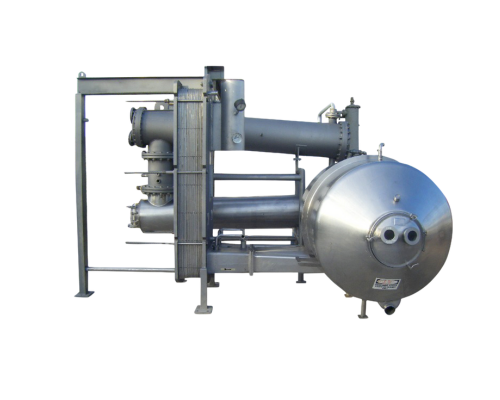
A plate-fin heat exchanger is constructed from layers of metal plates and corrugated fins.
The plates separate the different fluid streams, while the fins create flow passages and add a large amount of heat-transfer surface area.
That allows the exchanger to transfer heat efficiently while keeping the overall equipment relatively compact.
Depending on the design, plate-fin heat exchangers can also accommodate multiple streams within a single core.
That can be particularly useful in a processing facility where several heating and cooling duties need to happen in close proximity.
Of course, food processing comes with its own set of considerations.
The product itself, sanitation requirements, cleanability, materials of construction, operating temperatures, pressure, and potential for fouling all need to be evaluated before selecting a heat exchanger.
A plate-fin exchanger isn't automatically the right choice simply because it's compact.
The process has to come first.
Image from Genemco
Link to Plate-Fin Heat Exchangers
Where Are Plate-Fin Heat Exchangers Used in Food & Beverage Processing?
The food and beverage industry covers everything from dairy and beverages to sauces, prepared foods, meat, bakery products, and ingredients.
The equipment used to process those products can vary just as much.
Plate-fin heat exchangers may be used in applications where process fluids, utilities, gases, or refrigeration systems need to exchange heat efficiently within a compact footprint.
Here are some examples.
Dairy Processing
Dairy plants are full of heating and cooling duties.
Milk, cream, whey, water, and other dairy streams may need to be heated or cooled at different stages of processing.
While gasketed plate heat exchangers are extremely common in sanitary dairy applications, plate-fin technology may be considered for certain supporting or specialized duties where compactness and heat-transfer efficiency are important.
For example, a plate-fin exchanger may be used for utility-side heat transfer, refrigeration-related applications, or other process duties where the fluid and sanitation requirements are compatible with the exchanger design.
The important thing is matching the exchanger to the application—not forcing the application to fit the exchanger.
Beverage Processing
Beverage manufacturing can involve a surprising amount of temperature control.
Whether it's soft drinks, juices, alcoholic beverages, energy drinks, or other liquid products, the process may require cooling or heating at several points.
Plate-fin heat exchangers can be considered for certain beverage processing support applications, including:
- Process water cooling
- Glycol cooling
- Heat recovery
- Utility cooling
- Gas cooling
- Product-related heating and cooling where the exchanger design and sanitary requirements are appropriate
In a large beverage facility, even relatively small improvements in energy efficiency can become significant when equipment operates continuously.
Food Processing
Food processors may need to cool ingredients, heat sauces, chill process water, control cooking temperatures, or recover heat from one part of the facility for use somewhere else.
Plate-fin heat exchangers can be used in certain applications where compact, efficient heat transfer is needed.
For example, a refrigeration system may use a heat exchanger to transfer cooling capacity to a secondary fluid such as glycol.
That chilled fluid can then be circulated throughout the facility.
This approach allows the refrigeration system to do its job without necessarily putting refrigerant directly into every process application.
For facilities already operating complex ammonia refrigeration systems, heat exchangers can become an important link between the refrigeration plant and the production floor.
Heat Recovery: Don't Let Useful Heat Go to Waste
Food processing facilities use a lot of energy.
Heating. Cooling. Refrigeration. Hot water. Steam.
And much of that energy eventually leaves the process as waste heat.
That's where heat recovery can make a difference.
A heat exchanger can transfer heat from a warmer process or refrigeration stream into another stream that needs to be heated.
For example, heat rejected by a refrigeration system could potentially be recovered for water heating or another compatible process duty.
A plate-fin exchanger can be attractive for certain heat-recovery applications because it can provide a significant amount of heat-transfer surface without requiring a large footprint.
The basic idea is pretty simple:
Before you create more heat, see if you already have some you can use.
Process Water Cooling
Water plays a role in just about every food and beverage plant.
It's used for processing, cleaning, sanitation, ingredient preparation, cooling, and other plant operations.
Depending on the facility, large volumes of water may need to be cooled before use.
A refrigeration system can provide the cooling capacity, while a heat exchanger transfers that cooling to the water or another secondary fluid.
Plate-fin heat exchangers can be considered when the application benefits from compact construction and efficient heat transfer.
As always, water quality, cleanliness, corrosion potential, pressure, temperature, and sanitary requirements have to be evaluated when selecting the equipment.
Refrigeration & Secondary Cooling Systems
This is where food processing and industrial refrigeration come together.
Many food plants rely on large ammonia refrigeration systems to provide the cooling capacity needed throughout the facility.
Rather than using refrigerant directly in every cooling application, some systems use secondary fluids such as glycol or brine.
A heat exchanger can transfer the refrigeration system's cooling capacity into that secondary loop.
The secondary fluid then travels throughout the facility, providing cooling where it's needed.
For the right application, plate-fin technology can offer a compact method of transferring that thermal energy.
The refrigeration system stays focused on producing cold.
The heat exchanger helps distribute that cooling capability into the process.
Frozen Food & Cold-Temperature Applications
Frozen food production has obvious refrigeration requirements, but the process can involve more than simply "make it cold."
Products may need to be cooled rapidly between processing steps, ingredients may require temperature control, and refrigeration systems may need to maintain stable conditions throughout production and storage.
Heat exchangers can support these systems by transferring heat between refrigerants, secondary fluids, process streams, and other compatible media.
Plate-fin heat exchangers can be particularly interesting in applications where space is limited or where a high amount of heat transfer needs to happen within a relatively small package.
What About Sanitation and Cleanability?
This is where food processing applications require a little more thought.
A heat exchanger that works beautifully in an industrial gas application may not be appropriate for direct food contact.
Food and beverage processors have requirements that go beyond thermal performance.
Depending on the application, considerations may include:
- Product contact materials
- Sanitary design
- Cleanability
- CIP requirements
- Fouling potential
- Temperature
- Pressure
- Product viscosity
- Regulatory requirements
For direct product-contact applications, traditional sanitary plate heat exchangers may often be preferred because of their accessibility and cleanability.
Plate-fin heat exchangers can still have a place in food and beverage facilities, but they're often best evaluated for the specific application and service they're being asked to perform.
In other words, don't start with the question, "Can I use a plate-fin heat exchanger?"
Start with:
"What does this part of the process need the heat exchanger to do?"
Then work backward from there.
Plate-Fin vs. Other Heat Exchangers in Food Processing
Food processors have several heat-exchanger technologies to choose from.
A gasketed plate heat exchanger is widely used for sanitary liquid-to-liquid applications because it can be opened for inspection and cleaning.
A shell-and-tube heat exchanger can be a strong option for demanding applications, high pressures, higher temperatures, or situations where a rugged conventional design is preferred.
A scraped surface heat exchanger, sometimes called a Votator, is designed for viscous products that can stick to heat-transfer surfaces, such as certain creams, sauces, margarine, and other high-viscosity products.
A tube-in-tube heat exchanger provides a relatively straightforward arrangement where one fluid flows through an inner tube and another flows around it.
And then there's the plate-fin heat exchanger, which brings high surface-area density and compact construction to the conversation.
Each one has its place.
The goal isn't to determine which technology wins.
The goal is to find the technology that wins for your process.
When the New Equipment Won't Be Ready in Time
Here's a situation that happens in just about every industrial industry eventually.
A piece of equipment needs to be replaced.
The new unit is ordered.
Then comes the lead time.
Weeks turn into months, and production still has to happen in the meantime.
That's where pre-owned equipment can provide an alternative worth considering.
A used heat exchanger may be able to provide temporary capacity while a new unit is being manufactured. It could potentially serve as a replacement or help keep a process operating until the permanent equipment arrives.
It's not necessarily about choosing used equipment instead of new equipment.
Sometimes it's about using used equipment to get you from today to the day your new equipment arrives.
Image from Genemco
Link to Plate-Fin Heat Exchangers
Why Choose Genemco?
At Genemco, we know that equipment purchases usually come with a story.
Maybe a heat exchanger failed unexpectedly.
Maybe a production line is being expanded.
Maybe a customer needs capacity immediately.
Maybe the new equipment has a long lead time.
Or maybe the equipment you need is specialized enough that finding something available right now would be a huge advantage.
Genemco specializes in buying, selling, and appraising pre-owned industrial refrigeration and food processing equipment.
Our inventory spans a broad range of industrial equipment, giving customers another resource when they need to solve an equipment problem without necessarily starting with a new-build order.
For plate-fin heat exchangers, we'll help you look at what's available and determine whether a pre-owned unit could make sense for your application.
Because sometimes the most important feature of a piece of equipment isn't its age.
It's whether it can help you keep the line running.
OEMs: We Don't Want Your Customer—We Want to Help You Keep Them
If you're an OEM, we understand that your customer relationship is valuable.
You've done the engineering.
You've made the sale.
You've promised the customer a solution.
Then the customer asks:
"What do we do while we're waiting for it?"
That's where Genemco can help.
We don't want to take your sale.
We want to help you deliver it.
If your new equipment has a long lead time, consider Genemco as a temporary resource for your customer.
Maybe we're the bandaid that helps keep a production line moving through a short-term equipment problem.
Maybe it's a bigger issue and we're the tourniquet that helps keep the operation alive until the permanent equipment arrives.
Either way, the objective is the same:
Make you the hero.
Your customer still gets the new equipment they bought from you.
You still provide the long-term solution.
Genemco simply helps provide an option for the time in between.
Instead of telling your customer, "You'll have to wait," you can tell them:
"Let's see if Genemco can help us find something to keep you running until your new equipment is ready."
That's a much better position for everyone.
Because Production Doesn't Wait
Food and beverage processing is a business where timing matters.
Milk doesn't wait.
Ingredients don't wait.
Orders don't wait.
And production schedules certainly don't wait for a replacement heat exchanger.
Plate-fin heat exchangers can provide a compact and efficient heat-transfer solution for certain food and beverage applications, particularly where utility-side cooling, heat recovery, refrigeration integration, or specialized process requirements come into play.
But when equipment fails or a new project has a long lead time, the most important question may not be, "What's the perfect permanent solution?"
It might simply be:
"How do we keep running until we get there?"
That's where Genemco can help.
With a large inventory of pre-owned industrial refrigeration and food processing equipment, we give food and beverage processors, contractors, OEMs, and plant professionals another option to consider when time is of the essence.
Because sometimes you don't need a forever solution today.
You just need something that keeps the line moving until tomorrow's solution arrives.


