

In chemical processing, heat is rarely just something that needs to be removed.
It needs to be controlled.
A process may need to be heated to start a reaction, cooled to stop one, brought down to a specific temperature before separation, or cooled rapidly enough to protect product quality and equipment. In many plants, several of those things are happening at the same time.
That makes heat exchangers an important part of the bigger picture.
Among the options available to chemical processors, plate-fin heat exchangers can be particularly useful when the process calls for a compact design, high heat-transfer efficiency, multiple process streams, or tight temperature control.
They're not necessarily the right answer for every chemical process—and that's an important distinction. But when the application fits, a plate-fin heat exchanger can pack a lot of thermal performance into a surprisingly small package.
What Is a Plate-Fin Heat Exchanger?
A plate-fin heat exchanger is made up of alternating layers of metal plates and corrugated fins. The plates separate the individual fluid streams, while the fins create flow passages and significantly increase the available surface area for heat transfer.
Instead of relying primarily on the surface of a tube or flat plate, the fin structure creates a dense network of heat-transfer surfaces inside the exchanger.
The result is a compact piece of equipment capable of transferring heat between two or more process streams.
That multi-stream capability is particularly interesting in chemical processing.
Imagine a plant where one stream needs to be cooled, another needs to be warmed, and a third stream needs to be brought closer to its target temperature. Depending on the process and exchanger design, a plate-fin exchanger may be able to integrate multiple duties into one unit rather than requiring a collection of separate heat exchangers.
Less equipment can mean less footprint, less piping, and a simpler overall arrangement.
Of course, the process still has to dictate the design. Chemical compatibility, pressure, temperature, flow rate, fouling potential, cleaning requirements, and the physical properties of the fluids all have to be considered.
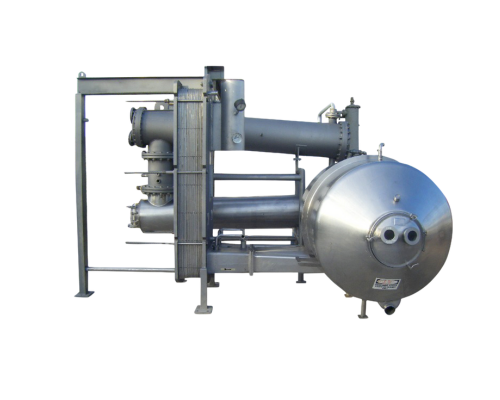
Image from Genemco
Link to Plate-Fin Heat Exchangers
Where Do Plate-Fin Heat Exchangers Fit Into Chemical Processing?
Chemical plants manufacture an enormous range of products, so there isn't one universal application for plate-fin heat exchangers.
Instead, they can show up at different points throughout a process where controlled heating and cooling are required.
Process Cooling
One of the most straightforward applications is cooling.
Chemical reactions and other processing steps can generate significant amounts of heat. If that heat isn't controlled, the process can move outside its intended operating range.
A plate-fin heat exchanger can transfer heat away from a process stream and into a cooling medium or another process stream.
The compact design can be especially useful when the plant has limited space or when a high heat-transfer duty needs to fit into a relatively small equipment area.
And when a process runs continuously, efficient heat removal isn't simply nice to have. It can be essential to keeping production stable.
Process Heating
The same basic principle works in reverse.
Chemical streams may need to be heated before entering a reactor, separator, distillation column, dryer, or another piece of process equipment.
Instead of using a completely separate heating source, a plant may be able to recover heat from another process stream.
A hot stream leaving one part of the plant can transfer some of that energy to a colder stream entering another part.
That creates an opportunity for heat integration.
The plant isn't simply generating heat and then throwing it away later. It's reusing energy already present in the process.
For facilities operating around the clock, that kind of efficiency can add up.
Heat Recovery: Making Better Use of Energy Already in the Process
Heat recovery is one of the most compelling reasons to consider a plate-fin heat exchanger in certain chemical applications.
Chemical plants often have streams operating at very different temperatures.
One stream might be leaving a process hot enough to require cooling. Another might be entering the process cold enough to require heating.
Why not put those two streams to work for each other?
A properly designed plate-fin heat exchanger can transfer heat between them without the fluids mixing.
This type of heat integration can potentially reduce the amount of external heating and cooling required.
And that can mean:
- Lower utility requirements
- Improved energy efficiency
- Reduced heating or cooling loads
- Better use of waste heat
- A more integrated process design
It's essentially getting more work out of energy that the plant already paid to produce.
Gas-to-Gas Heat Transfer
Chemical processing isn't limited to liquid streams.
Many chemical plants handle gases that need to be heated or cooled before moving to the next stage of the process.
Plate-fin heat exchangers are well suited to certain gas-to-gas applications because of their large heat-transfer surface area and compact construction.
A hot gas stream can transfer heat to a colder gas stream, or a process gas can be cooled using another gas stream that is already available within the system.
This can be especially useful when the process involves large gas flows or when space is limited.
Instead of adding another large piece of equipment, a compact plate-fin exchanger may provide the required thermal duty within a smaller footprint.
Chemical Separation & Distillation
Separation is at the heart of many chemical processes.
Distillation, condensation, evaporation, absorption, stripping, and other separation techniques all depend on controlling temperature and phase changes.
Heat exchangers can be used to condition streams entering or leaving these processes and to recover energy between hot and cold streams.
For example, a process may require a feed stream to be heated before entering a separation stage while a product stream leaving that same process needs to be cooled.
A heat exchanger can potentially connect those two duties.
The benefit isn't necessarily that the exchanger performs the separation itself.
Rather, it creates the thermal conditions that allow the separation process to work efficiently.
Condensation and Vapor Cooling
Chemical processing frequently involves vapor streams that need to be cooled or condensed.
As a vapor loses heat, it can change phase and become a liquid.
Plate-fin heat exchangers can be used in certain applications to cool vapor streams and recover heat during condensation.
This can be useful for product recovery, process control, and energy management.
The compact construction can also be advantageous where a large amount of heat-transfer duty needs to be handled without adding a large shell-and-tube exchanger to an already crowded process area.
Cryogenic and Low-Temperature Chemical Processing
Some chemical processes operate at extremely low temperatures.
This is where plate-fin heat exchangers can become particularly interesting.
Brazed aluminum plate-fin heat exchangers are widely used in cryogenic applications because they can provide efficient heat transfer at very low temperatures.
Chemical and petrochemical facilities may use cryogenic processes for gas separation, purification, liquefaction, and other specialized applications.
In these systems, plate-fin technology can allow multiple streams to exchange heat while maintaining close temperature approaches.
When the difference between "cold" and "really cold" is hundreds of degrees, efficient heat recovery becomes especially important.
Petrochemical Applications
The chemical and petrochemical industries have significant overlap, and plate-fin heat exchangers can be found in applications involving hydrocarbon processing, gas treatment, fractionation, and heat recovery.
For example, a facility may need to cool a hydrocarbon stream while simultaneously warming another process stream.
Plate-fin technology can provide the heat-transfer surface needed to accomplish that in a compact package.
Depending on the specific application, plate-fin exchangers may also be incorporated into systems involving:
- Hydrocarbon processing
- Natural gas treatment
- Gas separation
- Refrigeration
- Heat recovery
- Cryogenic processing
- Process gas cooling
- Condensation
The specific exchanger configuration depends heavily on the chemistry and operating conditions involved.
Why Not Just Use a Shell-and-Tube?
That's a fair question.
Shell-and-tube heat exchangers have been a staple of chemical processing for decades, and for good reason. They're rugged, proven, versatile, and available in countless configurations.
So plate-fin heat exchangers aren't intended to replace them across the board.
Instead, they offer a different set of advantages.
Plate-fin heat exchangers can be particularly attractive when:
- Space is limited
- High heat-transfer surface area is needed
- Multiple streams need to exchange heat
- Low temperatures are involved
- Gas-to-gas heat transfer is required
- Close temperature approaches are important
- Equipment weight or footprint needs to be minimized
Shell-and-tube exchangers may be preferable when:
- Heavy fouling is expected
- Mechanical cleaning is important
- The application involves particularly high pressures or temperatures
- A more conventional, rugged design is preferred
In chemical processing, there is rarely a one-size-fits-all answer.
The process gets the final vote.
The Reality of Chemical Processing: Equipment Problems Don't Wait
Here's the part that doesn't always make it into an equipment specification.
Production schedules don't stop because a replacement heat exchanger has a 20-week lead time.
A process doesn't necessarily care that a new unit is still being fabricated.
And customers don't generally want to hear, "We're waiting on the factory."
When a critical heat exchanger fails, the pressure to find a solution can be immediate.
That's one reason the market for pre-owned industrial equipment continues to be valuable.
A used piece of equipment may provide a way to address an immediate need while the permanent replacement is being manufactured.
It may be a temporary solution.
It may be a replacement.
It may simply buy the plant enough time to avoid turning an equipment problem into a production crisis.
Why Consider Genemco for a Plate-Fin Heat Exchanger?
At Genemco, we understand that industrial equipment is rarely purchased simply because someone wants another piece of machinery sitting in the plant.
There's usually a reason.
Something failed. Something is backordered. Production needs more capacity. A project got moved up. A customer needs equipment now.
That's where pre-owned equipment can provide another path forward.
Genemco specializes in buying, selling, and appraising pre-owned industrial refrigeration and food processing equipment. Our inventory includes equipment used across a wide variety of industrial applications.
For customers looking for a plate-fin heat exchanger, we can help explore available equipment and determine whether something in our inventory may fit the need.
Used equipment isn't automatically the answer.
But when the alternative is waiting months for a new unit while production sits on the sidelines, it's certainly worth exploring.
Image from Genemco
Link to Plate-Fin Heat Exchangers
OEMs: We're Here to Support Your Sale, Not Compete With It
If you're an OEM, here's something we want to make very clear:
We don't want to take your sale.
We want to help you keep it.
You've invested time developing the solution. You've earned the customer's confidence. You've made the sale.
But then comes the inevitable question:
"What are we going to do until the new equipment arrives?"
If your equipment has a long lead time, Genemco can potentially help provide a temporary solution.
Think of us as the bandaid that helps get your customer through a short-term equipment problem.
And if the situation is more serious?
Maybe we're the tourniquet that helps keep the operation running until the permanent equipment is ready.
The customer still gets the new equipment you sold them.
You still deliver the long-term solution.
And you get to be the person who helped them find a way through the immediate problem.
You make the sale. You remain the hero. We help bridge the gap.
That's a win for everyone.
Keeping Chemical Processing Moving
Heat transfer may be one piece of a chemical processing system, but when that piece isn't doing its job, the effects can quickly spread throughout the plant.
The right plate-fin heat exchanger can provide compact, efficient heat transfer for applications ranging from process cooling and heating to heat recovery, gas processing, separation, condensation, and cryogenic service.
And when a new exchanger is the right long-term answer but the plant needs something right now, pre-owned equipment can offer another option.
At Genemco, we're here to help customers explore those options.
Because sometimes the goal isn't to replace the permanent solution.
It's simply to keep the process running long enough for the permanent solution to arrive.


